A travel-gift power bank can pass a capacity check and still be refused under an airline's own policy. For TSA power bank rules and FAA passenger travel, keep the bank in carry-on baggage, use its watt-hour rating, and check the operating airline before calling it “airline approved.”
For airport retail and corporate travel assortments, a clearly marked bank at or below 100 Wh is the starting capacity screen, not a boarding guarantee. The FAA's October 2, 2026 guidance allows certain larger batteries with airline approval; IATA's March 2026 passenger guidance gives power banks a tighter 100 Wh ceiling and two-unit limit, and individual airlines can allow fewer. This guide separates those rules, checks two Anker model ratings, and gives buyers a record they can use before approving packaging or a gift order.
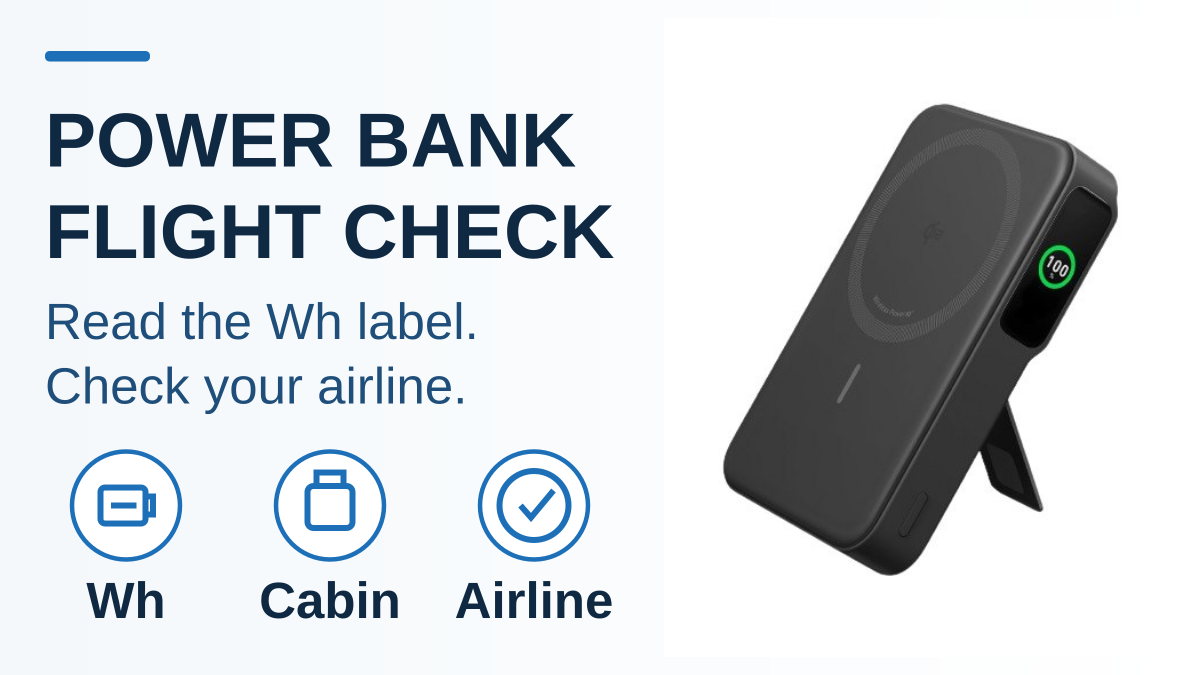
The banner shows the Anker A1654 MagGo 10K. A product's display or USB output wattage does not establish its battery energy or its acceptance on a particular flight.
What are the FAA power bank Wh limits?#
The US FAA baseline permits lithium-ion batteries up to 100 Wh, with carry-on-only treatment for power banks. Its larger-battery exception requires airline approval; it does not override an airline's stricter power-bank policy. The following table applies to ordinary personal-use passenger baggage, not mobility aids or freight.
Battery energy | FAA baseline | Dominant Failure Mode & Prevention |
|---|---|---|
At or below 100 Wh | Within the standard energy limit; power banks stay in the cabin | Treating capacity as universal approval: check quantity, stowage and use rules for every operating carrier |
Above 100 Wh, through 160 Wh | Airline approval required; at most two larger spare batteries per person | Assuming approval is automatic: obtain a carrier decision for the exact power bank before travel |
Above 160 Wh | Outside the ordinary passenger battery allowance | Trying to move it to checked baggage: arrange an appropriate freight solution instead |
Missing or unreadable rating | Acceptance cannot be established from a marketing capacity alone | Obtain the manufacturer's model documentation and a legible unit-label photo before selecting the lot |
Source: FAA Airline Passengers and Batteries, updated October 2, 2026. Its table expressly warns that airline, TSA security and international rules can be more restrictive. Checkpoint screening and airline carriage permission are separate checks.
A useful buying rule: if the documented rating exceeds 100 Wh, exclude the bank from a general travel-gift shortlist until the actual carrier confirms acceptance. A retailer should not use the FAA's larger-battery exception as a blanket “TSA approved” promise.
What changed in 2026, and which airline rule applies?#
ICAO announced a two-power-bank limit and a ban on recharging power banks during flight, effective March 27, 2026. National implementation and carrier policies still matter. IATA's March 31 operator guidance explains that adoption differs by jurisdiction; its passenger guidance and summary table are more restrictive on power banks above 100 Wh.
Source or carrier | Documented power-bank condition | What the buyer should record |
|---|---|---|
IATA passenger guidance, March 31, 2026 | At most two banks, each no more than 100 Wh; no recharging the bank from aircraft power | Capacity and quantity for the intended itinerary; do not extend the general spare-battery approval exception to this table |
Southwest | One bank per customer from April 20, 2026; no more than 100 Wh; no overhead storage or onboard recharging; visible when used | A one-bank gift allocation and packing instructions matching the airline's current page |
Emirates announcement, effective October 1, 2025 | One bank under 100 Wh; no use or recharging onboard; no overhead storage; capacity information required | Confirm the current rule, particularly for a unit rated exactly 100 Wh |
The IATA operator document distinguishes the ICAO addendum's 100–160 Wh approval provision from the tighter IATA passenger table and the planned 2027 DGR treatment. This is why an approval statement needs the airline, date and exact device, rather than a universal label. Sources: ICAO announcement, IATA operator guidance, and IATA passenger guidance.
Check the Southwest battery policy and Emirates announcement directly before issuing traveler instructions. For a connection or codeshare, confirm each airline actually operating a flight. Permission to carry a bank does not necessarily include permission to use it.
How do you convert mAh to Wh without using USB voltage?#
Multiply battery capacity in ampere-hours by its nominal battery voltage. Use capacity and voltage stated on the same basis: pack capacity with pack voltage, or the manufacturer's equivalent cell capacity with the corresponding cell voltage. A USB output voltage is a different measurement.
Energy (Wh) = capacity (mAh) × nominal battery voltage (V) ÷ 1,000.
Hypothetical worked example: 10,000 mAh × 3.7 V ÷ 1,000 = 37 Wh. Using a 5 V USB output rating for that same capacity would produce 50 Wh and misstate the battery energy. These inputs explain the calculation; they are not a specification for every 10K bank. The formula follows the FAA guidance above.
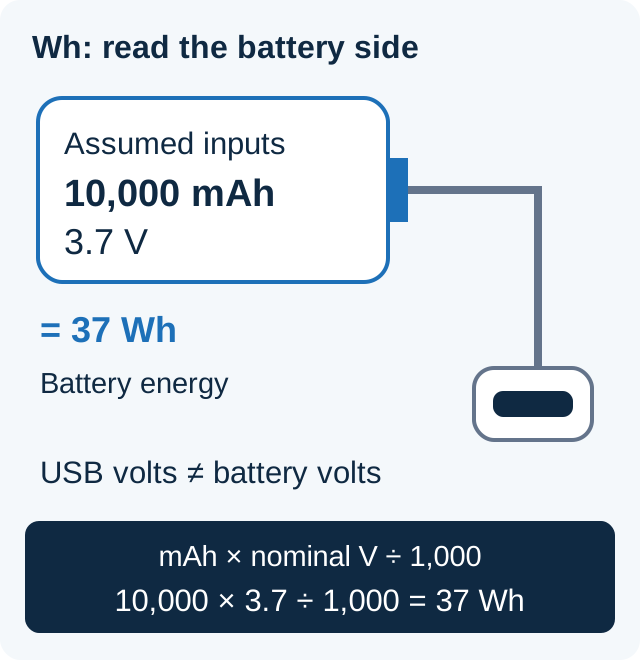
Battery energy calculation uses nominal cell voltage, while the USB port voltage belongs to the output side.
There is no universal 27,000 mAh flight limit. With explicitly assumed inputs, 27,000 × 3.7 ÷ 1,000 = 99.9 Wh, whereas 27,000 × 3.85 ÷ 1,000 = 103.95 Wh. The second example exceeds 100 Wh despite using the same mAh number. Use the manufacturer's marked Wh rating and matching documentation; do not round a result down to fit a limit.
A high output rating, such as 300 W, describes power delivery. Wh describes stored energy. Neither a fast-charging claim nor the battery's current charge percentage replaces the rated-Wh check.
Which Anker models fit the 100 Wh capacity screen?#
Anker's published specifications put A110A at 99.75 Wh and A1654 at 38.5 Wh. These are model-level energy references for a shortlist. Final acceptance also requires the exact regional unit, its condition, recall status and the airline policy.
Exact model | Manufacturer's battery rating | Capacity-screen result | Dominant Failure Mode & Prevention |
|---|---|---|---|
A110A Prime Power Bank, 26K, 300W | 26,250 mAh; 99.75 Wh | Below 100 Wh | Confusing 300 W output with Wh, or substituting another Prime model: match A110A and the actual housing label |
A1654 MagGo Power Bank, 10K | 10,000 mAh at 3.85 V DC; 38.5 Wh | Below 100 Wh | Accepting any “MagGo 10K” as equivalent: retain the exact model and regional label photo |
Sources checked October 19, 2026: Anker A110A product description and Anker A1654 specification table. Anker lists 99.75 Wh for A110A; use that value rather than an unverified 99.6 Wh entry in a buying spreadsheet.
Before accepting a lot, follow the recall lot-check workflow against current official notices. Capacity alone cannot clear a recalled or damaged battery. For mainland China domestic itineraries, add the separate checks in our China CCC travel guide.
What should travelers do before a bag is gate-checked?#
Remove the power bank and keep it in the cabin before the bag goes into the hold. Protect it against damage and short circuits. The FAA PackSafe lithium battery guidance specifically covers this gate-check situation.
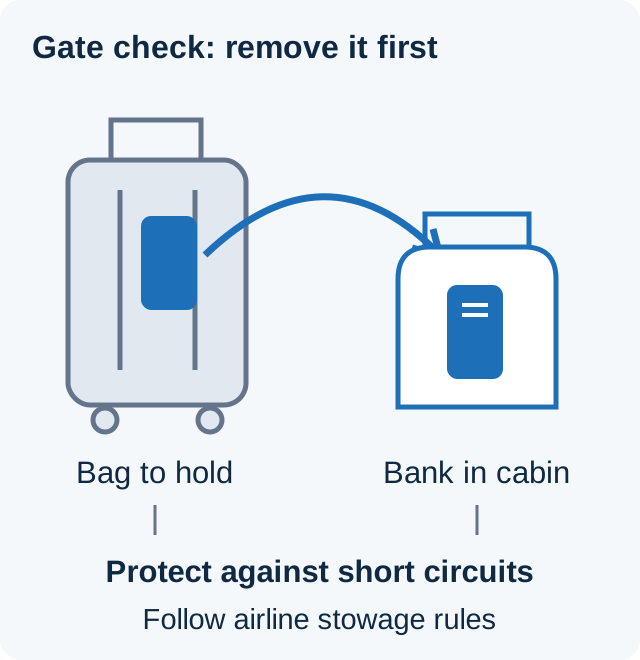
At gate check, remove the power bank from the suitcase and keep it with the passenger in a protected cabin pouch.
Give each recipient a checklist they can use:
- Read the Wh rating and exact model on the unit; keep the matching manufacturer information available.
- Check the operating airline's current quantity, storage and use rules before departure.
- Keep each bank protected from short circuits and damage, separate from loose metal objects.
- Remove it before a cabin bag is gate-checked; follow the carrier's instructions about where it stays in the cabin.
- Do not travel with damaged or recalled batteries. Tell airport staff or cabin crew if a device becomes hot, swollen, smoky or starts burning.
The FAA personal-use baggage exception does not cover batteries carried for resale or distribution, including vendor samples. Do not send a wholesale carton with an employee as though it were a personal travel allowance. Use the power bank RFQ guide to separate the product order from its freight arrangements.
What should a travel-retail buyer put in the RFQ?#
Keep the model evidence and the traveler policy in separate fields. Start with the power bank category, then state what the intended travel assortment must satisfy. Ask for the quoted regional version and supporting label information rather than a generic “airline-approved certificate.”
What to send us | Why it matters | Example format |
|---|---|---|
Exact model, color and quantity | Prevents a capacity or model substitution | One line per A110A or A1654 variant |
Destination market and packaging language | Identifies the regional version requested | Country and required carton language |
Intended airlines and itinerary | Sets the recipient instructions that you must confirm | Operating carriers, connections and travel date |
Required Wh/model-label evidence | Makes the capacity check traceable | Legible housing photo linked to the quote line |
Handoff point and substitution rule | Keeps logistics and model changes explicit | Mainland China/Hong Kong handoff; named approval contact |
Compare quotes over the same order and delivery scope. Total order cost equals product cost plus packaging, label/document checks, freight and handling, plus any rework or replacement costs you actually incur. Use supplier quotations and your own incident records for those inputs; no fixed rejection rate or saving applies to every travel order. If you need companion wall chargers or cables, list them separately using the mixed-SKU order guide.
Request a wholesale quote under our published terms with the model lines, region, quantities and label requirements above. Stock, regional availability, documents and delivery scope belong in the written quotation. The airline decides passenger acceptance.
Method, sources and review date#
Updated October 19, 2026. This guide compares current FAA passenger guidance, ICAO's March 27 announcement, IATA's March 31 guidance, the cited airline policies and Anker's exact-model specifications. The official links beside each rule let buyers check the applicable wording. The worked calculations use stated hypothetical inputs; the shortlist uses manufacturer ratings. It does not certify a batch or replace an operating carrier's decision, and it does not cover bulk dangerous-goods freight procedures.