
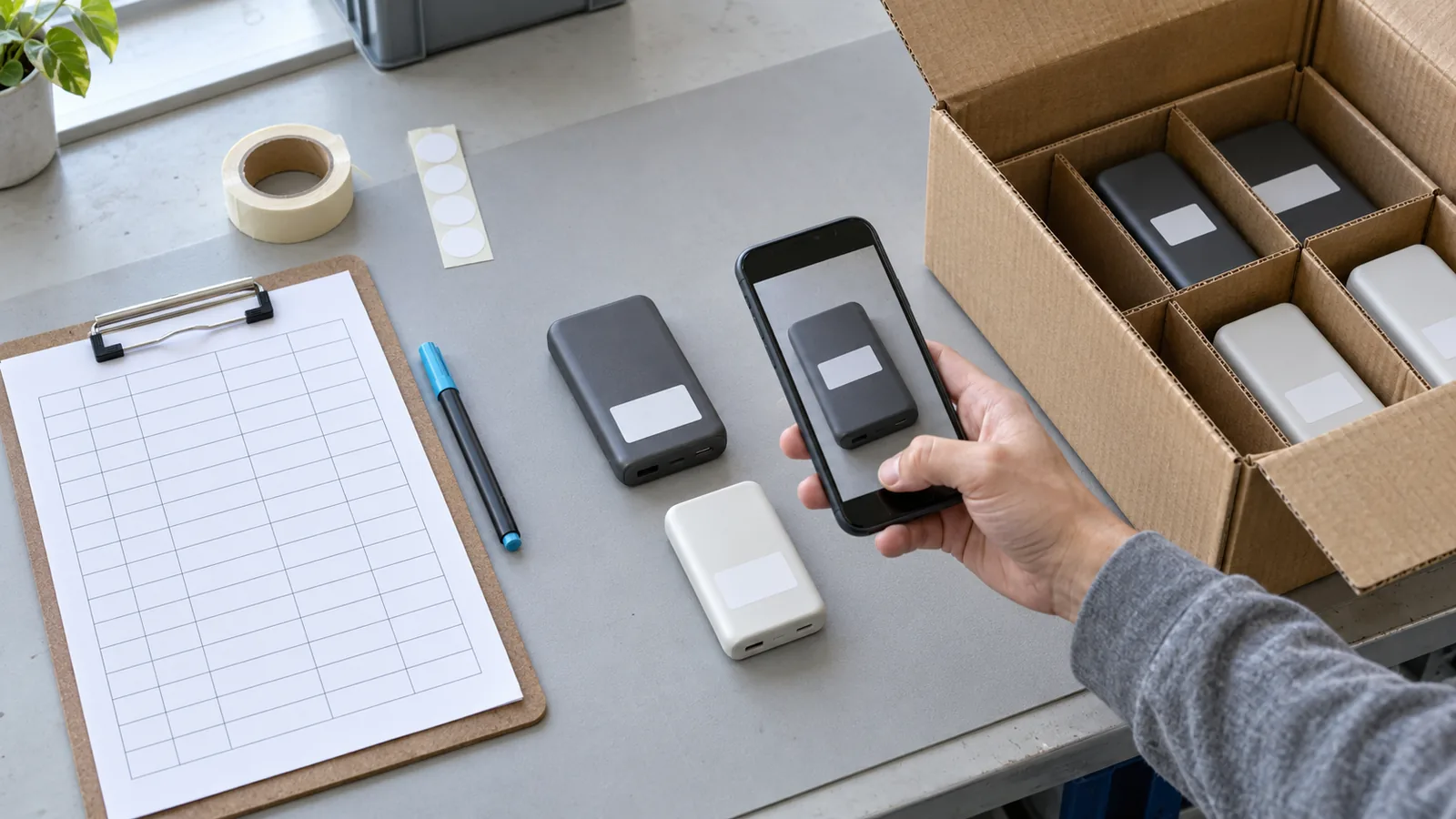
A power bank received without a recorded recall check can end up on the wrong side of a recall: on a shelf after Anker has told owners to stop using it. On 11 October 2026, Anker's US recall page lists two campaigns: a voluntary global recall of models A1647, A1652, A1257, A1681 and A1689, and a US-only recall of the PowerCore 10000, model A1263. This guide explains how to check those campaigns one unit at a time and gives you a lot-check log to record each result.
If you hold Anker power banks for resale, the model code printed on each unit is the first filter. Anker's rc2506 notice names A1647, A1652, A1257, A1681 and A1689; a separate notice names A1263 units made between 1 January 2016 and 30 October 2019 and sold in the United States between 1 June 2016 and 31 December 2022. A matching model is not yet a result, because Anker confirms each unit by serial number or purchase details. These are the campaigns on Anker's US page. They are examples, not a complete list for every market, so check the recall page for the market where each unit was sold.
- Read the model code on the unit. "PowerCore 10000", "MagGo" and "10K" are names and capacities, not model codes.
- Match each unit to a campaign by where and when it was originally sold. The global rc2506 notice and the US-only A1263 notice set different conditions, and the market you will resell into does not decide either.
- Check each unit, then record the time, Anker's exact result and the evidence.
- Keep units with an unreadable serial number, missing order details, an unknown original sale market or a conflicting result open, with a named owner.
- Recall eligibility and remedies come from Anker. A supplier can only answer evidence questions about its own quotation.
Which Anker power banks are on the current recall pages?#
Anker's US product-recalls page, read on 11 October 2026, links two campaigns and labels both "Recalled in June, 2025". One is a voluntary global recall of five models. The other covers the PowerCore 10000, model A1263, sold in the United States. The table summarises what each official notice states.
| Campaign | Models named | Scope stated by the source | How a unit is checked |
|---|---|---|---|
| rc2506 — voluntary global recall | A1647 Power Bank (20,000mAh, 22.5W, built-in USB-C cable) · A1652 MagGo Power Bank (10,000mAh, 7.5W) · A1257 Power Bank (10K, 22.5W) · A1681 Zolo Power Bank (20K, 30W, built-in USB-C and Lightning cable) · A1689 Zolo Power Bank (20K, 30W, built-in USB-C cable) | Anker describes a voluntary global recall coordinated with regulators in all regions. US notice: CPSC recall 25-466, dated 18 September 2025, about 481,000 units sold in the US from August 2023 through June 2025. | Model number on the back or side, then the serial number or proof of purchase through the form linked from the notice. |
| A1263 — PowerCore 10000 recall | A1263 Anker PowerCore 10000 (black, blue, red and white) | Manufactured 1 January 2016 to 30 October 2019 and sold 1 June 2016 to 31 December 2022, only in the United States. Anker says the notice was issued jointly with the CPSC. | Product name and model number on the bottom, then the serial number and order number through the A1263 recall form. |
The five-model campaign is set out in Anker's rc2506 recall notice, and the US figures come from the CPSC notice for recall 25-466. The A1263 conditions come from Anker's A1263 recall notice. Anker's index labels both campaigns June 2025, while the CPSC notice for the five models is dated 18 September 2025. Record each date as its source states it.
Anker's recall page has a country and region selector, and this guide is based on the US page. Open the page for the market where the unit was sold, because the campaigns and the claim route there can differ. Quotations should name the same printed codes; the exact-model catalog shows how this site writes model references. A family listed on the power bank procurement page says nothing about a particular unit's recall status.
Why is Anker recalling these power banks?#
For the five rc2506 models, Anker says its expanded quality checks found a potential manufacturing issue with lithium-ion battery cells from a single vendor. Anker describes the likelihood of malfunction as minimal and says it is recalling out of caution. The CPSC notice states the hazard plainly: the battery can overheat, posing fire and burn hazards. It also reports that the firm received 33 reports of fire and explosion incidents, with four minor burn injuries and one report of substantial property damage. For A1263, Anker's notice says the battery may overheat, which can melt plastic parts and cause smoke and fire.
This matters in a warehouse because a normal-looking unit can still be in the recall. Anker's rc2506 notice says a unit confirmed as part of the recall should not be used, even if it appears to work normally. It also says not to dispose of the unit until Anker confirms that it qualifies. A charge or function test therefore tells you nothing about recall status, and a unit that passes one is not cleared.
Was the Anker 10000 power bank recalled?#
Some 10,000mAh Anker models are in a recall, but "Anker 10000" is not a model code. The PowerCore 10000 model A1263 is recalled for units made and sold within the windows in Anker's A1263 notice, and only for units sold in the United States. The MagGo Power Bank A1652 (10,000mAh, 7.5W) and the Power Bank A1257 (10K, 22.5W) are in the separate rc2506 campaign. Other 10K models are not named in these two campaigns, but that does not clear them in every market.
Read the code printed on the unit. Anker places A1263's product name and model number on the bottom of the device; the rc2506 notice puts the model number on the back or side. Write down the code you can see, not the name on a listing or invoice.
The same rule applies when quoting. The PowerCore buying page notes that "PowerCore 10K" describes a capacity band, not a purchasing SKU. MagGo is also a family name used on more than one 10,000mAh model. The Nano and MagGo page lists the exact references this site quotes, and a different model code is still not a recall result. Check the campaign page for the unit's market.
What should a lot-check log record?#
Record one row per unit, per applicable campaign, per check. Each row holds the purchase line, the exact model, where and when the unit was originally sold, the destination market, the serial number and its photo, the campaign and its official URL, the time of the check, Anker's result in its own words with evidence, any exception and the person responsible. With that, someone else can repeat the check later and reach the same record.

Each column has a job:
- Purchase line and unit reference tie the unit back to the quoted line and carton. Use the same stable line numbers as your RFQ; the power bank RFQ guide explains why line numbers should not change between revisions.
- Exact model is the code printed on the unit.
- Original sale market and date, with evidence record the country where the unit was first sold and when, backed by an invoice or distributor document. This is what campaign conditions refer to: the A1263 recall covers units made between 1 January 2016 and 30 October 2019 and sold in the United States between 1 June 2016 and 31 December 2022. If you do not know where a unit was first sold, record that as an open question for Anker.
- Destination market is where you plan to resell the unit. Record it separately. It tells you which local rules you face, but it cannot select a campaign or rule one out.
- Serial number and photo reference. Anker's notices warn that characters such as 1, L, I, 2, Z, 0 and O are easy to confuse, and say that affected serial numbers do not contain the letters O or I. Keep a photo of the label so the transcription can be checked. Do not use the letter rule to decide a result yourself.
- Campaign and official URL name one campaign per row. If two campaigns could apply to a unit, use two rows.
- Checked at, with time zone, because campaigns change. A date alone, or "checked OK" in the result cell, cannot show later which version of the campaign page the row reflects. Anker's rc2506 FAQ recommends checking A1647 and A1652 units again even if they were not affected in an earlier recall.
- Result as worded by Anker, with evidence: a screenshot file name, an email or a case number.
- Exception records what is missing or conflicting.
- Owner and next action give a named person and the date of the next review.
Unit-level evidence also matches how Anker reviews claims. The A1263 recall form asks for the serial number, order details and photos, and requires photos of each individual device when more than one unit is submitted.
Copy the lot-check log#
Copy these columns into a spreadsheet. The example row fills in only the model and campaign taken from Anker's rc2506 notice. Every order-specific cell is blank because no unit has been checked here. The log has ten columns, so scroll the table sideways to see them all.
| Line / unit ref. | Exact model | Originally sold in + date (evidence) | Destination market | SN + photo ref. | Campaign + official URL | Checked at (time zone) | Result as worded by Anker + evidence | Exception / open question | Owner + next action |
|---|---|---|---|---|---|---|---|---|---|
| A1652 · Anker MagGo Power Bank (10,000mAh, 7.5W) | rc2506 voluntary global recall · anker.com/rc2506 | ||||||||
For the status column of your own sheet, use working labels that describe what you know: awaiting evidence, unable to verify, affected per Anker's result or result recorded for the named campaign. These are buyer management labels, not Anker terms. Avoid "safe", "cleared", "certified" or "all recalls checked", because a row covers one campaign at one time. A label describes the record; it does not release the unit for sale.
Add a short summary for each purchase line: units logged, units with open rows, campaigns checked and the owner. Do not carry a sample result over to units that were not checked. If the order mixes power banks with chargers and cables, keep this log for the power bank lines and leave the shared commercial terms where the mixed-SKU order guide puts them.
Check one purchase line in five steps#
The check follows the order Anker's notices use, with a record kept at each step.
- Read the model code on each unit and photograph the label. For the rc2506 models it is on the back or side; for A1263 it is on the bottom.
- Open the recall page for the market where the unit was originally sold, and compare its sale date with each campaign's window. If the original market is unknown, keep the row open and ask Anker; do not pick or exclude a campaign by the destination market alone. If no campaign on that page names the model, record the page, the time and "model not listed on this page". That is a note about the page, not a safety result.
- Check the unit the way that campaign asks. For rc2506, Anker asks for the serial number or proof of purchase through the form linked from its notice. For A1263, it asks for the serial number and order number, and says to contact Anker if the order number cannot be found or the serial number is worn off.
- Save Anker's result in its own words, with the time, time zone and evidence reference. The A1263 notice asks owners to confirm that a unit is in the recall before marking it and uploading photos, so do not mark units first.
- Give every open row an owner and keep the unit out of saleable stock. A completed row is a record, not a release. If Anker's result says a unit is affected, the row is complete but the unit stays out of sale and use, and Anker's instructions for that unit decide what happens next.
How to record exceptions without guessing#
An exception is any row where you cannot record an official result for the unit. Record it as open, name an owner and ask Anker. Never fill the result cell with "not affected".
| Situation | What to record | Who resolves it |
|---|---|---|
| Serial number worn or unreadable | Label photo, "SN unreadable", campaign page checked | Anker (the A1263 notice says to contact Anker) |
| No order number or proof of purchase | Purchase line, supplier invoice reference if any, "order no. missing" | Anker for eligibility; the supplier for purchase documents |
| Printed code differs from the quotation | Printed code, quoted code, label photo | Supplier corrects the quotation; check the printed code |
| Original sale market or date unknown, or mixed regional versions | Origin stated by the supplier, invoice or distributor documents, packaging region, photos, "original market unknown" | Supplier for purchase documents; Anker for which campaign applies |
| Result changes on a later check | New row with time and result; keep the old row | Anker; the owner notes which result is current |
| Form asks for something you cannot provide | Screenshot of the request, time | Anker support named on the notice |
Anker's notices say an affected unit should not be thrown away until Anker confirms that it qualifies. This guide does not give return, shipping or disposal steps; follow the instructions Anker gives for the unit. Whether the supplier and stock are genuine is a separate check, covered by the supplier verification guide through seller identity, cartons and serial photos.
What the log cannot prove#
A completed row records one check of one unit against one campaign at one time. It does not prove that the rest of the lot is unaffected, that the stock is genuine or that a seller is authorized, and it does not create a return right.
- Not the whole lot. A result on sample units says nothing about units that were not checked.
- Not every campaign. The log covers the campaigns you checked, for the markets you checked.
- Not supplier status. Anker Wholesale is the B2B RFQ channel of GuangZhou Duohuo Technology Co., Ltd, not Anker's consumer store or corporate purchasing portal; About Anker Wholesale sets out that evidence boundary.
- Not a wholesale remedy. The refund or gift card in the rc2506 programme and the replacement offered for A1263 are Anker programmes for owners, not wholesale return or credit terms. The terms for an order are what the written quotation says; the pricing and RFQ terms page explains the published starting terms.
- Not a legal opinion on resale. The CPSC notice states that US federal law prohibits any person from selling products subject to a Commission-ordered recall or a voluntary recall undertaken in consultation with the CPSC. Other markets have their own rules; check them with the relevant authority or your adviser.
When this does not apply#
- You own one device. Go straight to Anker's recall pages; you do not need a log.
- The product is outside these campaigns. The columns still work for other recalls, but the campaign table here only covers the two Anker campaigns above.
- You have not read the recall page for the market where the unit was sold. The table reflects Anker's US page only.
- You need a regulatory or legal decision. The log supports that decision but does not make it.
- The question is battery transport. Carrier acceptance and dangerous-goods classification are outside this guide.
Ask for unit-level evidence before you buy#
If you are buying power banks through this site, put the evidence request in the RFQ, not after delivery. Send the purchase lines, the exact model codes, the destination market and the evidence you need for each unit, including where and when the units were originally sold. Then ask which of it can be provided for the quoted lines. Recall eligibility and remedies stay with Anker.
| Item | Why it is needed | Example format |
|---|---|---|
| Purchase line numbers | Ties each unit's evidence to a quoted line | PB-01, PB-02 |
| Exact model codes | Matches each unit to a campaign | Printed model code for each line |
| Original sale market and date | Campaign conditions refer to where and when a unit was sold | Country and invoice date, with document reference |
| Destination market | Shows which local rules apply to your resale | United States |
| Unit evidence requested | Lets you run the serial-number check before payment | Label photo showing model and SN, one per unit |
| Open questions | Keeps unresolved points visible in the quotation | SN unreadable on carton 3 |
Carton or shipping-mark photos do not show each unit's model code and serial number, so the serial-number check cannot run from them. Send the list on WhatsApp and ask which evidence can be provided for your lines. Only Anker can confirm whether a unit is part of a recall.
Recall questions buyers ask#
The first three questions come from Google search suggestions and "People also ask" results. The last three are support questions from the FAQ on Anker's rc2506 notice, answered here for buyers who hold stock.
What Anker power banks are recalled?
Anker's US recall page, read on 11 October 2026, names A1647, A1652, A1257, A1681 and A1689 in a voluntary global recall. It also names PowerCore 10000 model A1263, for units made from 1 January 2016 to 30 October 2019 and sold only in the United States from 1 June 2016 to 31 December 2022. This is not a worldwide list; check the page for the market where each unit was sold.
Why is Anker being recalled?
For the five-model recall, Anker cites a potential manufacturing issue with lithium-ion cells from a single vendor, and the CPSC says the battery can overheat, posing fire and burn hazards. For A1263, Anker says the battery may overheat, causing melting, smoke and fire.
Was the Anker 10000 power bank recalled?
PowerCore 10000 model A1263 was, for units made from 1 January 2016 to 30 October 2019 and sold in the United States from 1 June 2016 to 31 December 2022. MagGo A1652 (10,000mAh) and A1257 (10K) are in the separate rc2506 recall. Check the printed model code, not the capacity.
Where can I find the model number and the serial number on my product?
On the device itself. For the rc2506 models, Anker says the model number is on the back or side and the serial number is usually printed on the side or back. For A1263, both are on the bottom. Photograph the label for the log, because characters such as 0 and O are easy to confuse.
Can I continue using the power bank if it seems fine?
No, not if Anker confirms the unit is part of the recall. Anker says a confirmed unit should be stopped from use immediately even if it appears to work normally. For stock, that means the unit stays out of use and sale, whatever a charge test shows.
If my A1647 / A1652 was not affected in last year's recall, do I still need to check it again this year?
Yes. Anker recommends checking these units again. "Last year" and "this year" are the words Anker uses in the rc2506 campaign, referring to an earlier recall; they do not describe a new recall in 2026. Log the new check as a new row.
Methods, sources and updates#
This guide is compiled from public sources. Anker's US product-recalls page, the rc2506 and A1263 notices (including their FAQs) and the A1263 recall form were read on 11 October 2026, and the CPSC notice for recall 25-466 was read the same day. We did not read Anker's recall pages for other regions, did not submit a recall form and did not check any unit. The lot-check log is a buyer's working sheet prepared by the Anker Wholesale editorial team; it is not an Anker form. Updated 11 October 2026.
- Anker: Product Recalls (US page) — campaign index with the country and region selector.
- Anker: rc2506 voluntary global recall notice — models, reason, model and serial-number checks, FAQ.
- Anker: A1263 PowerCore 10000 recall notice — US-only scope, manufacturing and sales windows, worn serial numbers.
- Anker: A1263 recall form — serial number, order details and per-unit photos.
- CPSC: Anker Power Banks Recalled Due to Fire and Burn Hazards (recall 25-466) — US recall date, hazard, units and sale period.
Recall pages change. Check the official page on the day you record a result. Other procurement guides are listed on the Anker wholesale buying guides page.
