Procuring bulk power banks for corporate gifting campaigns, event welcome kits, or enterprise laptop deployments requires aligning four operational decisions before issuing a purchase order: wholesale lot commercial terms, exact model code selection, factory-sealed custom packaging, and dangerous-goods pallet freight preparation. Buyers exploring the Anker power bank wholesale catalog and our buying guides index can structure mixed-device or single-model lots by matching hardware form factors and export paperwork to the target recipient group.
| Procurement stage | Specification to lock on the RFQ line | Operational issue prevented |
|---|---|---|
| Commercial channel separation | Wholesale RFQ lot terms versus direct retail corporate checkout programs | Prevents applying retail checkout return assumptions or resale restrictions to wholesale lots |
| Hardware tier and model code | Printed model code, battery energy, port architecture, and housing format | Prevents silent substitution between stand-equipped magnetic packs, slim packs, and laptop bricks |
| Custom logo presentation | External paperboard sleeve, outer gift box, or branded pouch around factory-sealed stock | Prevents breaking factory seals, obscuring outer-case energy marks, or voiding coverage via housing alteration |
| Battery transport dossier | Model-matched battery test summary and freight forwarder cargo declaration | Prevents air or sea carrier booking holds caused by missing laboratory report identifiers |
| Master carton and pallet staging | Outer carton gross mass cap, standalone battery marks, and pallet overpack lettering | Prevents freight rejection when shrink-wrapped pallets hide inner carton lithium battery markings |
Wholesale RFQ Lot Terms Versus Direct Retail Corporate Purchase Programs#
Procurement teams reviewing our published wholesale pricing terms and power bank wholesale RFQ guide separate wholesale lot supply from direct retail corporate checkout programs before requesting a quote:
- For power banks, chargers, and hubs, the starting order quantity is 10 units in total with no per-SKU device minimum, and one order can mix device models.
- For cables and small accessories, the starting minimum is 20 units per SKU, and every length or color combination is its own line.
- Wholesale order value must exceed US$2,000; an order of exactly US$2,000 does not meet the threshold.
- Wholesale payment is by T/T or L/C as confirmed in the RFQ, and there is no card checkout for wholesale lots.
- Handoff is at a nominated address in mainland China or Hong Kong, or via buyer-arranged UPS/DHL pickup, where responsibility changes hands.
- Onward export (FOB, DDP) is not included unless the signed quotation adds it, so buyers must budget onward freight and battery documents separately.
- Unit price and stock are provided by written quotation only, and no public price list or stock count is published.
- RFQ submissions list one model per line with quantity, acceptable substitutes, destination market, payment preference, and handoff city, with a reply within 24 hours.
- Published power-bank models with exact catalog pages on Anker Wholesale are A110A, A1654, and A1664, while other Prime, PowerCore, Nano, or MagGo references can be quoted from a printed model and label photo.
Direct retail corporate programs operate under different resale, brand-mixing, and return rules:
- Resale of products purchased through the Anker Corporate Purchase Program is not permitted, and orders across multiple brands are not supported.
- Undamaged products can be returned within 30 days of purchase under Anker US's 30-day guarantee, excluding corporate purchases or bulk orders of 10 or more units of the same product.
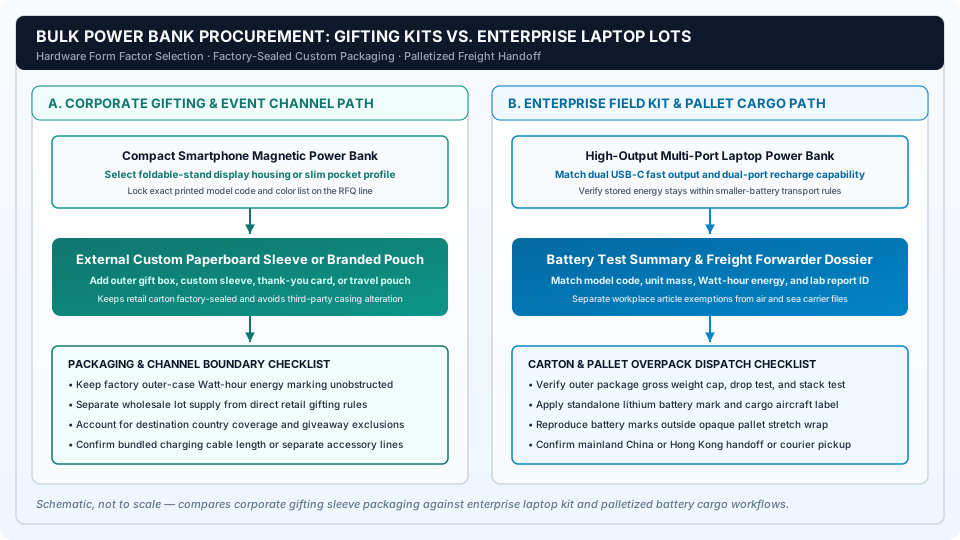
Schematic, not to scale: match smartphone gifting lots to external sleeve or pouch packaging while pairing enterprise laptop power banks with hazardous cargo files and pallet overpack markings.
Capacity Tiers and Exact Model Selection for Corporate Gifting and Enterprise Laptop Kits#
Matching battery capacity and port architecture to the recipient device profile prevents under-sizing event gifts or over-spending on commuter kits, especially when pairing portable batteries with our laptop power bank compatibility guide:
- For company gifting or events, Anker recommends power banks with at least 10,000mAh or more, as they can charge most phones 2-3 times.
- Typical custom power bank capacity ranges between 3,000mAh and 10,000mAh for smartphones (whose batteries are around 2,500 to 4,000mAh), while higher capacities like 20,000mAh are suggested for tablets or multiple charges.
Within the smartphone magnetic tier, the Anker MagGo Power Bank and the Anker MagGo Slim Power Bank serve distinct gifting use cases and cannot be swapped silently on a purchase order:
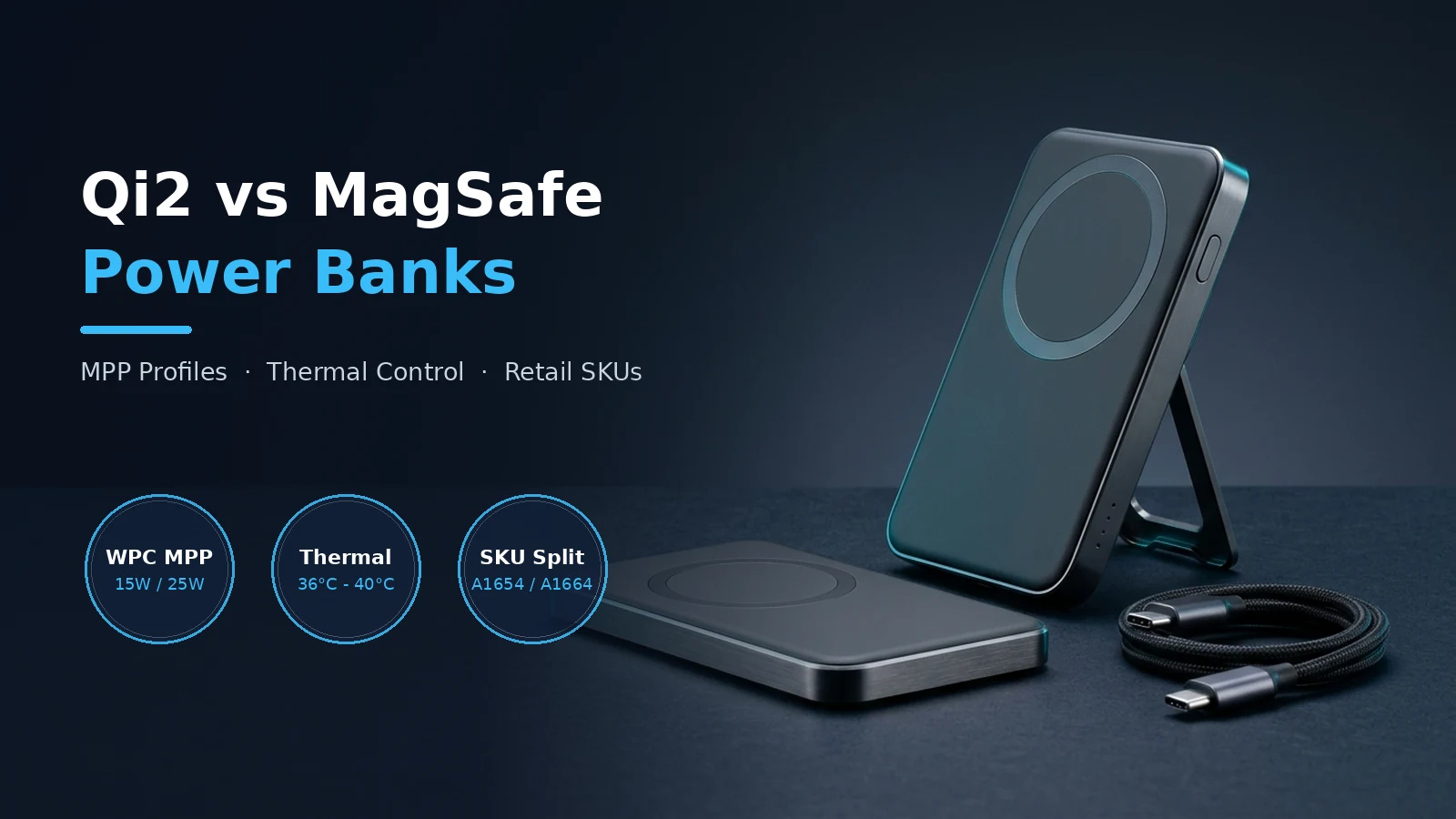
- Model A1654 includes Qi2 wireless charging, a smart display, and a foldable stand, whereas the slimmer A1664 is a different 10K magnetic reference.
- Model A1654 has a 10,000mAh / 38.5Wh battery capacity, 15W maximum wireless output, up to 27W USB-C output, 1 × USB-C port, dimensions of 107.3 × 68.8 × 19.8 mm, and a weight of 250 g.
- On Anker's official A1654 specification sheet, battery capacity is rated at 10000mAh 3.85Vdc/38.5Wh, USB-C input is 5V⎓3A / 9V⎓2.22A, USB-C output is 5V⎓3A / 9V⎓3A, recharging time is 165mins, and a 60cm USB-C to USB-C cable is included.
- Model A1664 is a slim 10,000mAh MagGo reference with 15W wireless output, up to 30W USB-C input and output, 1 × USB-C port, dimensions of 4.09 × 2.78 × 0.58 in, and manufacturer-listed colors Black Stone, Aurora White, Teal Oasis, and Pink Aura.
- Model A1664 measures 4.09 × 2.78 × 0.58 in (104 × 70.6 × 14.7 mm), weighs 7.62 oz (215.9 g), supports USB-C input of 5V⎓3A / 9V⎓3A / 15V⎓2A, and supports USB-C output of 5V⎓3A / 9V⎓3A / 12V⎓2.5A / 15V⎓2A / 20V⎓1.5A.
- Due to a 35% to 45% capacity loss during charging, a fully charged Anker MagGo Power Bank (10K, Slim) provides about 5,500mAh to 6,500mAh of usable power to devices.
- On model A1664, ActiveShield monitors temperatures over 3 million times daily and maintains operation temperatures below 104°F (40°C), compared to the industry standard of 118.4°F.
For field engineers, executive travel kits, and mobile workstation deployments, high-wattage multi-port bricks such as the Anker Prime Power Bank deliver sustained laptop output while staying inside the smaller-battery energy ceiling:
- Model A110A has a 26,250mAh battery capacity, 300W maximum total output, 140W maximum single-port output, and 2 × USB-C and 1 × USB-A ports.
- Model A110A measures 159.9 × 38 × 62.7 mm (6.3 × 1.5 × 2.5 in) and weighs 600 g (1.32 lb).
- Model A110A provides 26,250mAh (99.75Wh) of battery energy and 300W total output across three ports.
- Each USB-C port on the Anker Prime Power Bank (26K, 300W) supports 5V⎓3A / 9V⎓3A / 12V⎓3A / 15V⎓3A / 20V⎓5A / 28V⎓5A (140W Max), USB-C input reaches 28V⎓5.36A (150W Max) under Anker Protocol, and USB-A output is 5V⎓3A / 9V⎓2A / 10V⎓2.25A / 12V⎓1.5A (22.5W Max).
- Supports 250W max dual-port fast recharging using both USB-C ports with 5A cables and 140W chargers, recharging to 50% in 13 minutes and 80% in 40 minutes.
- During power conversion on the 26,250 mAh power bank, 30 - 45% energy loss is normal, so a fully charged unit provides about 15,200 mAh to devices.
- ActiveShield 4.0 monitors temperature 120 times per second, providing approximately 10,368,000 checks per day.
- In Anker's bulk power bank guide, the Anker 737 Power Bank carries a 24,000mAh battery capacity, is compatible with more than 1,000 devices, recharges 7x faster, and uses ActiveShield 2.0 to monitor temperature 3,000,000 times per day.
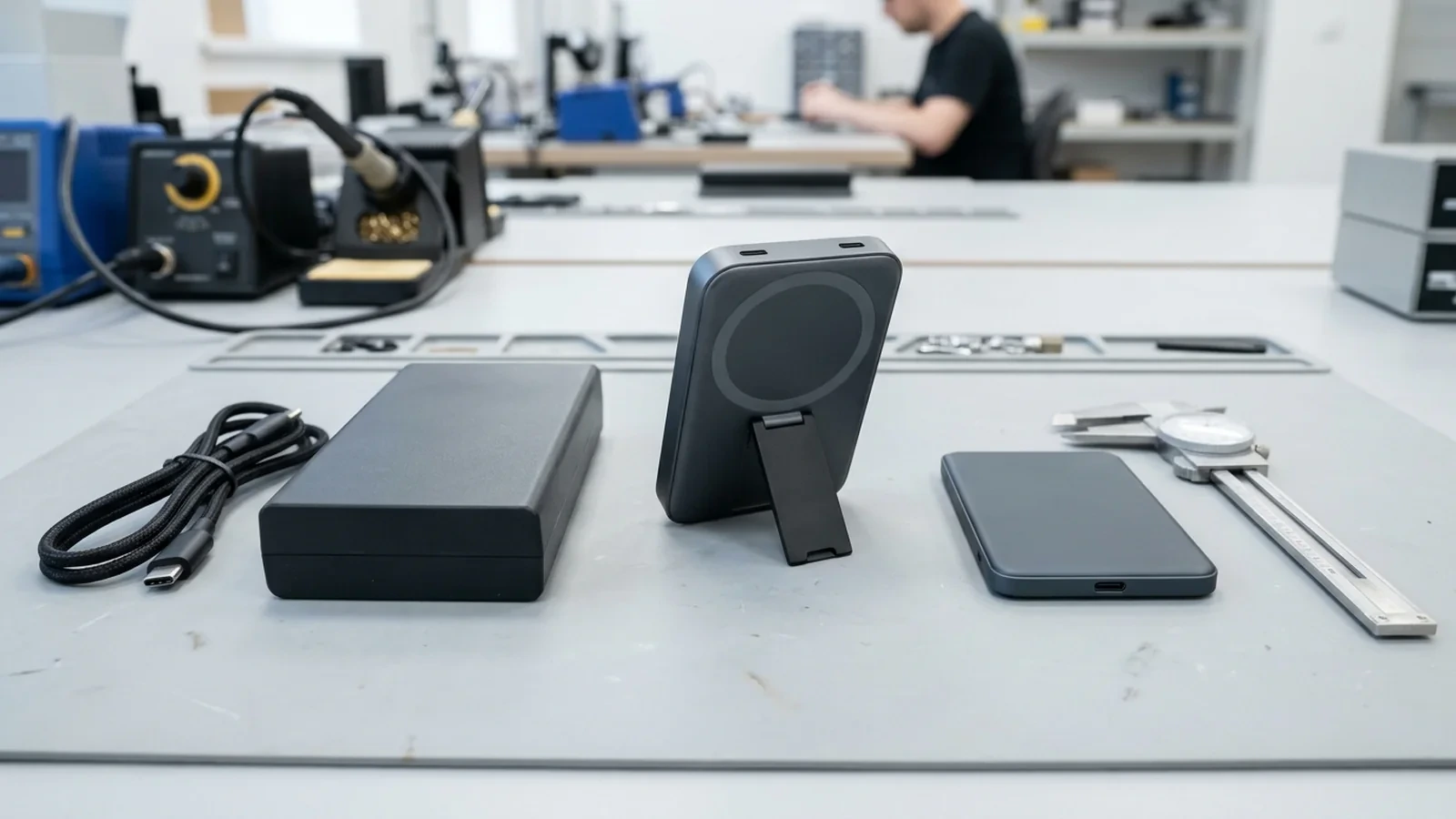
Hardware tier comparison: separate high-output laptop power bank bricks from stand-equipped and slim magnetic smartphone packs on every purchase order line.
Custom Logo Power Bank Packaging, Casing Materials, and Coverage Boundaries#
When promotional distributors and corporate marketing teams plan a custom logo power bank program alongside our cross-border stock planning guide, preserving original factory-sealed cartons and regulatory housing markings avoids post-handoff coverage gaps:
- Anker's custom power bank guide outlines five customization approaches: Logo Placement, Color Selection, Unique Shapes and Designs, Brand Packaging using a branded box or sleeve, and Add Personalization with a thank-you note or branded pouch.
- Anker MagGo Power Bank (10K, Slim) features a sleek matte finish, a sturdy metal frame, and aerogel thermal insulation, and comes with a 23.62 in / 60 cm USB-C to USB-C cable and 24-month warranty.
- Quotes for published power bank models on Anker Wholesale cover genuine, unused products in factory-sealed packaging.
- Under § 173.185(a)(5), beginning May 10, 2024, each lithium-ion battery must be marked with the Watt-hour rating on the outside case.
Manufacturer terms also define coverage duration, expected service life, and exclusions for promotional giveaways, third-party modifications, and cross-border distribution:
- In the United States, Anker's standard warranty period is 24 months for Anker GaNPrime, Prime, and MagGo power banks, 36 months for Anker PowerCore Reserve, and 18 months for other power banks.
- Anker custom power banks carry a limited warranty for defects in materials and workmanship when purchased through AnkerDirect or authorized resellers, and last 2-3 years with regular use or up to 4 to 5 years if used occasionally and stored properly.
- Under Anker US's Limited Warranty exclusions, free products or promotional giveaways, third-party repairs or modifications, unauthorized resellers, and damage from unauthorized modification are not covered.
- Anker's limited warranty applies only in the country of original purchase and becomes void if taken outside that country or shipped internationally from an authorized online order.
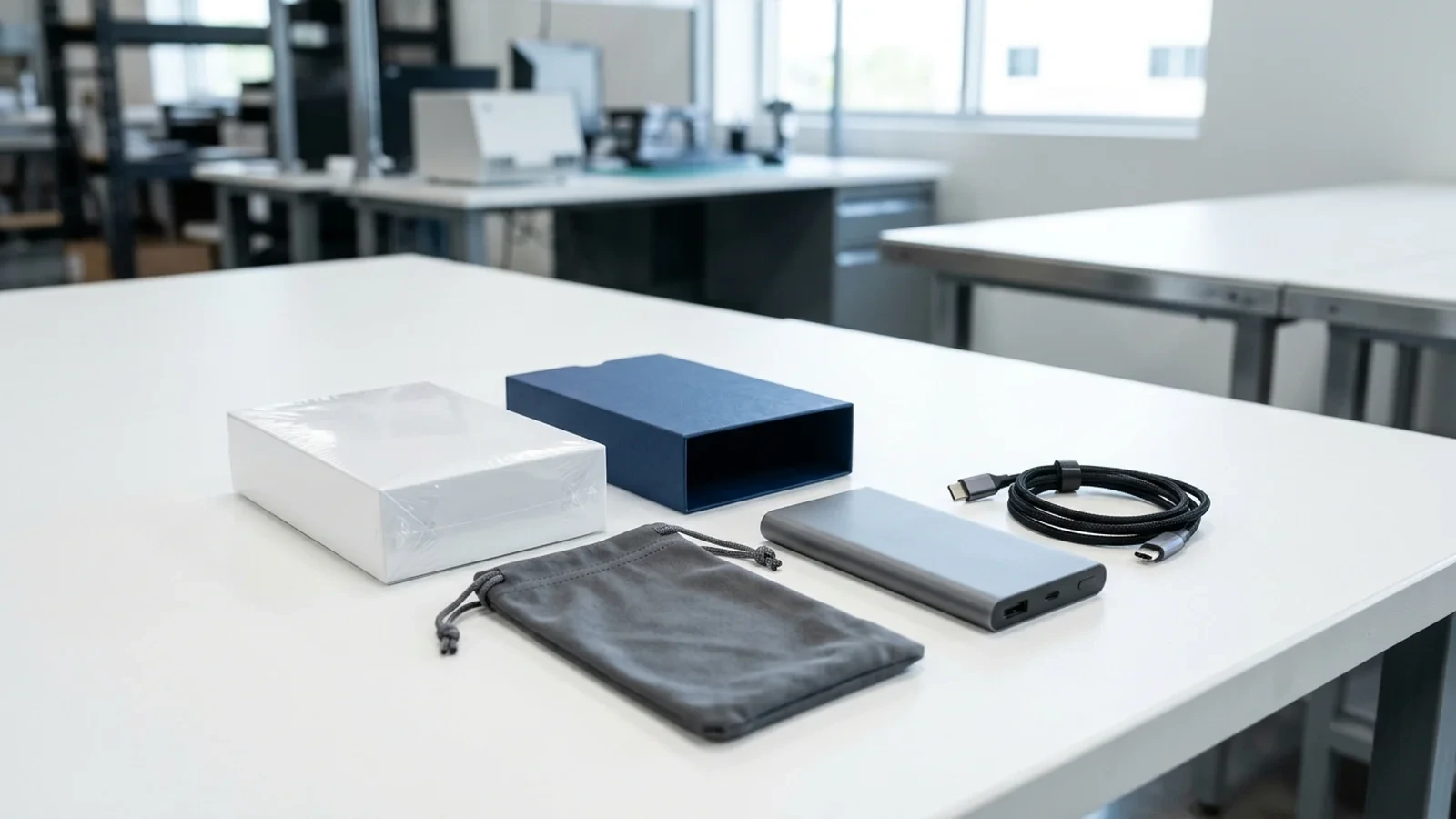
External branding workflow: slip a custom paperboard sleeve or outer gift pouch over the factory-sealed carton to keep the original seal and housing energy markings intact.
Dangerous Goods Documentation, Battery Test Summaries, and Pallet Overpack Rules#
Before booking air or ocean freight after mainland China or Hong Kong handoff, logistics teams reconcile commercial invoice Watt-hour figures—detailed in our power bank Watt-hour invoice calculation guide—with federal and international battery transport rules:
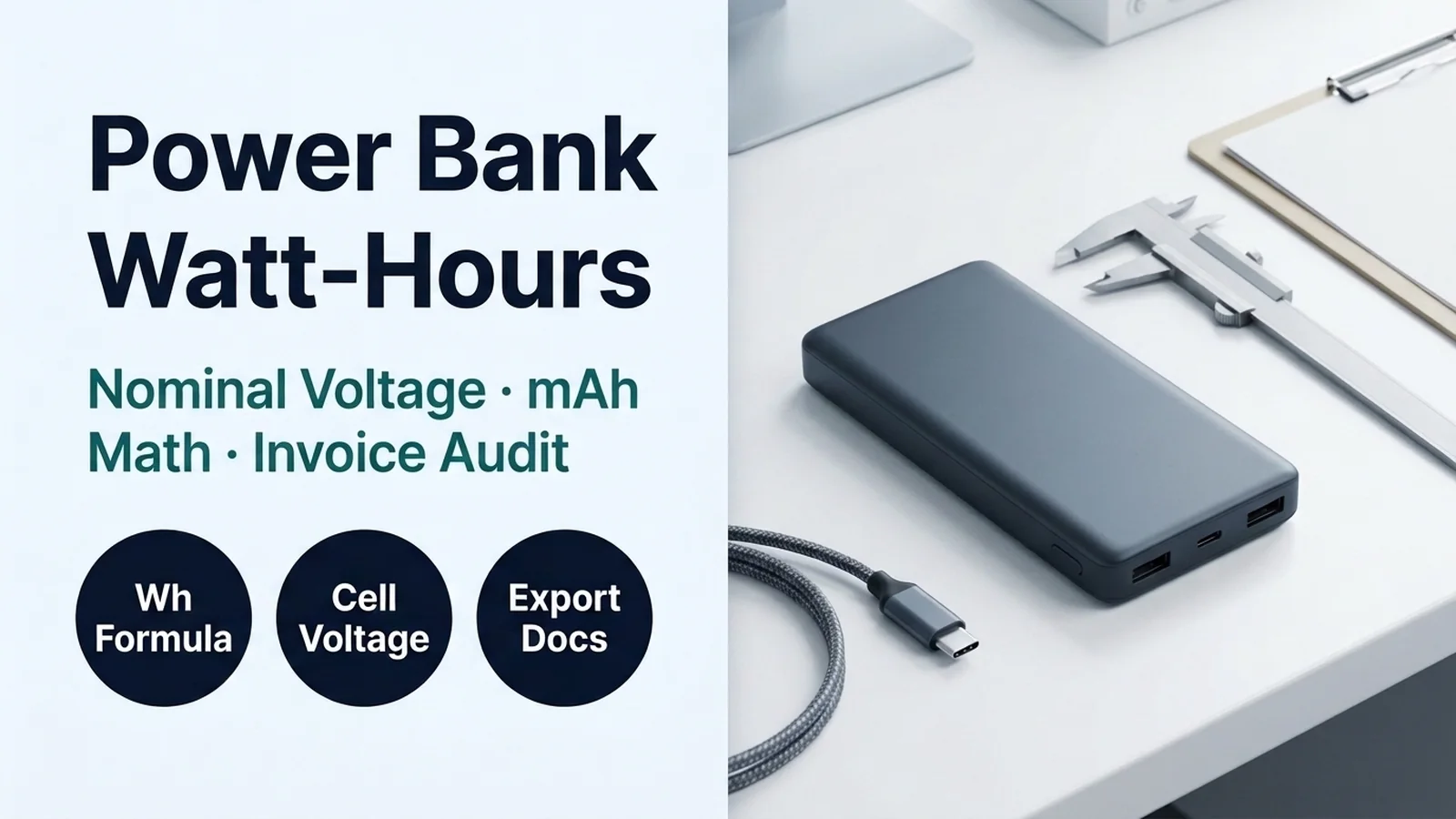
- Watt-hour (Wh) means a unit of energy equivalent to one watt (1 W) of work acting for one hour (1 h) of time, calculated by multiplying rated capacity in ampere-hours by nominal voltage: Watt-hour (Wh) = ampere-hour (Ah) × volts (V).
- Under § 173.185(a)(1), each lithium cell or battery must be of the type proven to meet the criteria in part III, sub-section 38.3 of the UN Manual of Tests and Criteria.
- Under § 173.185(a)(2), each lithium cell or battery manufacturer must create a record of satisfactory completion of testing (e.g. test report) and maintain it for as long as that design is offered for transportation and for one year thereafter.
- Under § 173.185(a)(3), each manufacturer and subsequent distributor of lithium cells or batteries (except button cells installed in equipment) manufactured on or after January 1, 2008, must make a test summary available.
- A lithium battery test summary must include the cell, battery, or product manufacturer's name and contact information, the test laboratory's name and contact information, a unique test report identification number, and the date of the test report.
- A test summary must also include cell or battery mass, Watt-hour rating or lithium content, physical description, model number, list of tests conducted and results, and the name and title of a responsible person.
- Under § 1910.1200(b)(6)(v) and (c), the Hazard Communication Standard (including Safety Data Sheets under § 1910.1200(g)) does not apply to “articles,” defined as manufactured items formed to a specific shape or design that under normal conditions of use do not release more than minute or trace amounts of a hazardous chemical.
Carton specification, gross weight limits, drop and stack testing, and pallet overpack markings govern how standalone power banks move across air, ocean, and ground networks, while individual travelers consult our passenger airline power bank guide for cabin carry-on limits:
- Fully regulated packages of lithium cells or batteries must use non-metallic inner packagings that completely enclose them, placed in Packing Group II outer packagings such as 4G fiberboard, 4A/4B/4N metal, 4C1/4C2/4D/4F wooden, or 4H1/4H2 solid plastic boxes.
- To qualify for smaller-battery exceptions, the Watt-hour (Wh) rating may not exceed 20 Wh for a lithium-ion cell or 100 Wh for a lithium-ion battery, and lithium content may not exceed 1 g for a lithium metal cell or 2 g for a lithium metal battery.
- Except when lithium cells or batteries are packed with or contained in equipment in quantities not exceeding 5 kg net weight, outer packages of smaller lithium batteries must be marked “LITHIUM ION BATTERIES—FORBIDDEN FOR TRANSPORT ABOARD PASSENGER AIRCRAFT” or labeled with a “CARGO AIRCRAFT ONLY” label.
- Except when contained in or packed with equipment, each smaller-battery package must not exceed 30 kg (66 pounds) gross weight and must withstand a 1.2 meter drop test in any orientation without damage or battery-to-battery contact.
- The lithium battery mark must indicate “UN3480” for standalone lithium-ion cells or batteries (or “UN3481” when contained in or packed with equipment) on a rectangle or square at least 100 mm (3.9 inches) wide by 100 mm (3.9 inches) high with 5 mm (0.2 inches) edging (or 100 mm by 70 mm on small packages).
- For air transportation of smaller standalone lithium-ion cells or batteries, a package containing no more than 10 kg lithium-ion cells or batteries is excepted from UN performance packaging when displaying both the lithium battery mark and the Class 9 Lithium Battery label (§ 172.447), and must pass a 3-meter stack test for 24 hours.
- An overpack is an enclosure used by a single consignor to protect or consolidate two or more packages—such as packages placed or stacked onto a load board like a pallet and secured by strapping, shrink wrapping, or stretch wrapping.
- When packages are placed in an overpack, the lithium battery mark shall be clearly visible or reproduced on the outside of the overpack, and the overpack shall be marked with the word “OVERPACK” in lettering at least 12 mm (0.47 inches) high.
- IATA's 2025 Battery Guidance Document aligns with the 66th Edition of the IATA Dangerous Goods Regulations (DGR), and effective January 2025, a 3m stack test requirement applies to non-UN specification packaging under PI 966-II, PI 967-I and II, PI 969-II, and PI 970-I and II.
- Under FAA PackSafe rules for airline passengers, spare (uninstalled) lithium-ion batteries including power banks must be carried in carry-on baggage only, are limited to 100 watt hours (Wh) per battery, and up to two spare larger lithium-ion batteries (101–160 Wh) may be carried with airline approval.
When consolidating a wholesale lot through the Anker power bank wholesale catalog, buyers can verify our wholesale pricing and handoff terms and company verification profile before sending their model list.
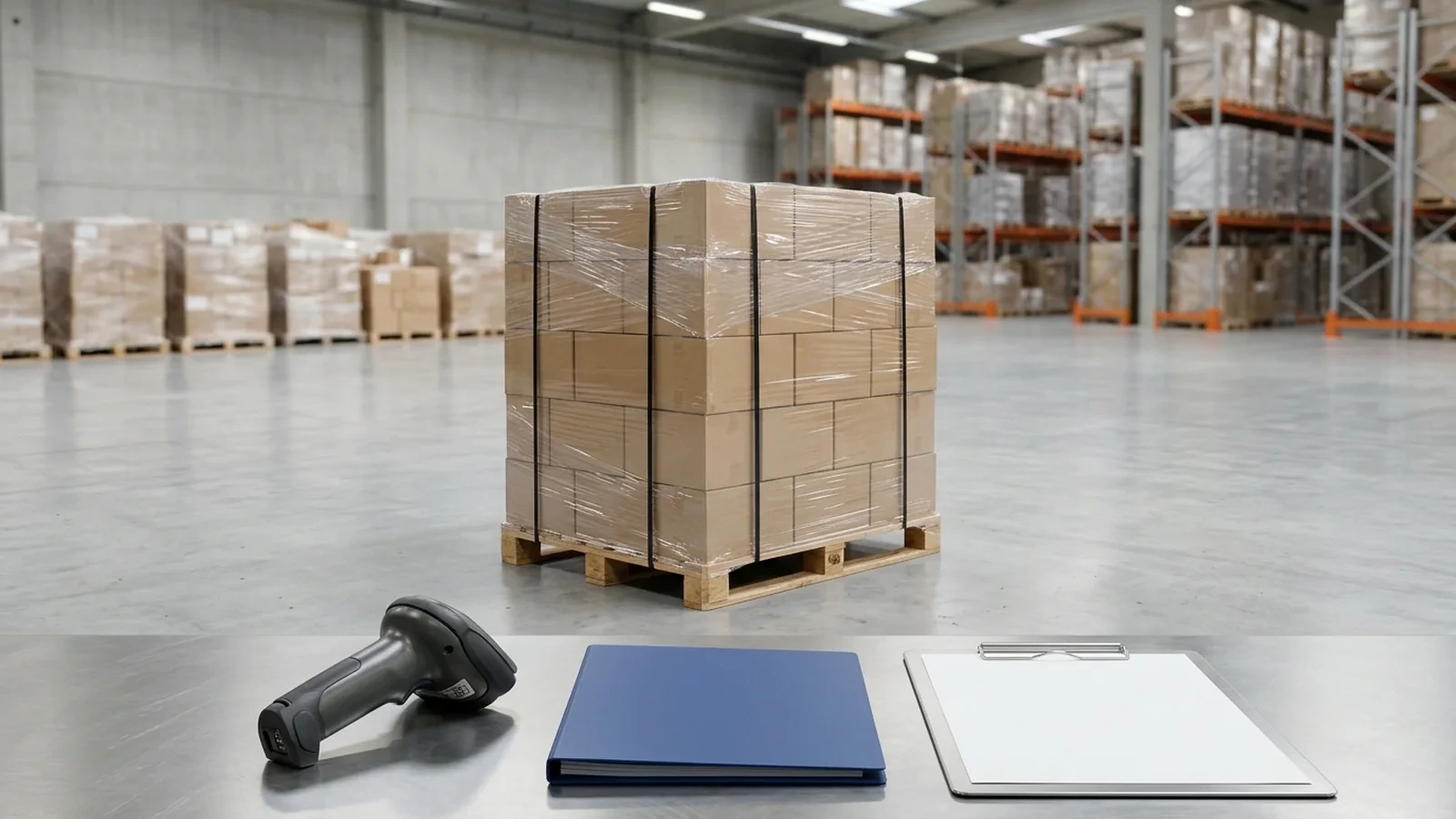
Pallet export staging: reproduce carton battery markings on the exterior of stretch-wrapped pallet overpacks and align the battery test summary before freight pickup.
Frequently Asked Questions#
What starting order quantities and payment terms apply when sourcing Anker bulk power banks on Anker Wholesale?
For power banks, chargers, and hubs, the starting order quantity is 10 units in total with no per-SKU device minimum, and one order can mix device models. Wholesale order value must exceed US$2,000; an order of exactly US$2,000 does not meet the threshold. Wholesale payment is by T/T or L/C as confirmed in the RFQ, and there is no card checkout for wholesale lots.
What battery capacity does Anker recommend when selecting bulk power banks for corporate gifting or company events?
For company gifting or events, Anker recommends power banks with at least 10,000mAh or more, as they can charge most phones 2-3 times.
What customization approaches does Anker outline for custom power bank branding and packaging?
Anker's custom power bank guide outlines five customization approaches: Logo Placement, Color Selection, Unique Shapes and Designs, Brand Packaging using a branded box or sleeve, and Add Personalization with a thank-you note or branded pouch.
How must palletized overpacks of lithium-ion power banks be marked for freight transport?
When packages are placed in an overpack, the lithium battery mark shall be clearly visible or reproduced on the outside of the overpack, and the overpack shall be marked with the word “OVERPACK” in lettering at least 12 mm (0.47 inches) high.
Sources#
- Anker Wholesale — Wholesale Pricing and Starting Terms (/pricing)
- Anker Wholesale — Power Banks Category Catalog (/power-banks)
- Anker Wholesale — Published Anker Prime and Anker MagGo Power Bank Product Pages
- Anker Official Guide — Bulk Power Banks for Company Gifting
- Anker Official Guide — Custom Power Banks for Brand Marketing
- Anker Official Program — Corporate Purchase and Gifting Program
- Anker Official Product Documentation — Anker Prime and Anker MagGo Technical Specifications
- Anker Official Customer Support — Refund Policy and Product Coverage Terms
- U.S. Department of Transportation and PHMSA (via eCFR) — Federal Hazardous Materials Definitions and Lithium Battery Transport Rules
- U.S. Department of Labor (via eCFR) — Workplace Hazard Communication Rules for Manufactured Articles
- International Air Transport Association (IATA) — Lithium Battery Guidance Document for Dangerous Goods Cargo
- U.S. Federal Aviation Administration (FAA) — PackSafe Airline Passengers and Lithium Batteries Guidance