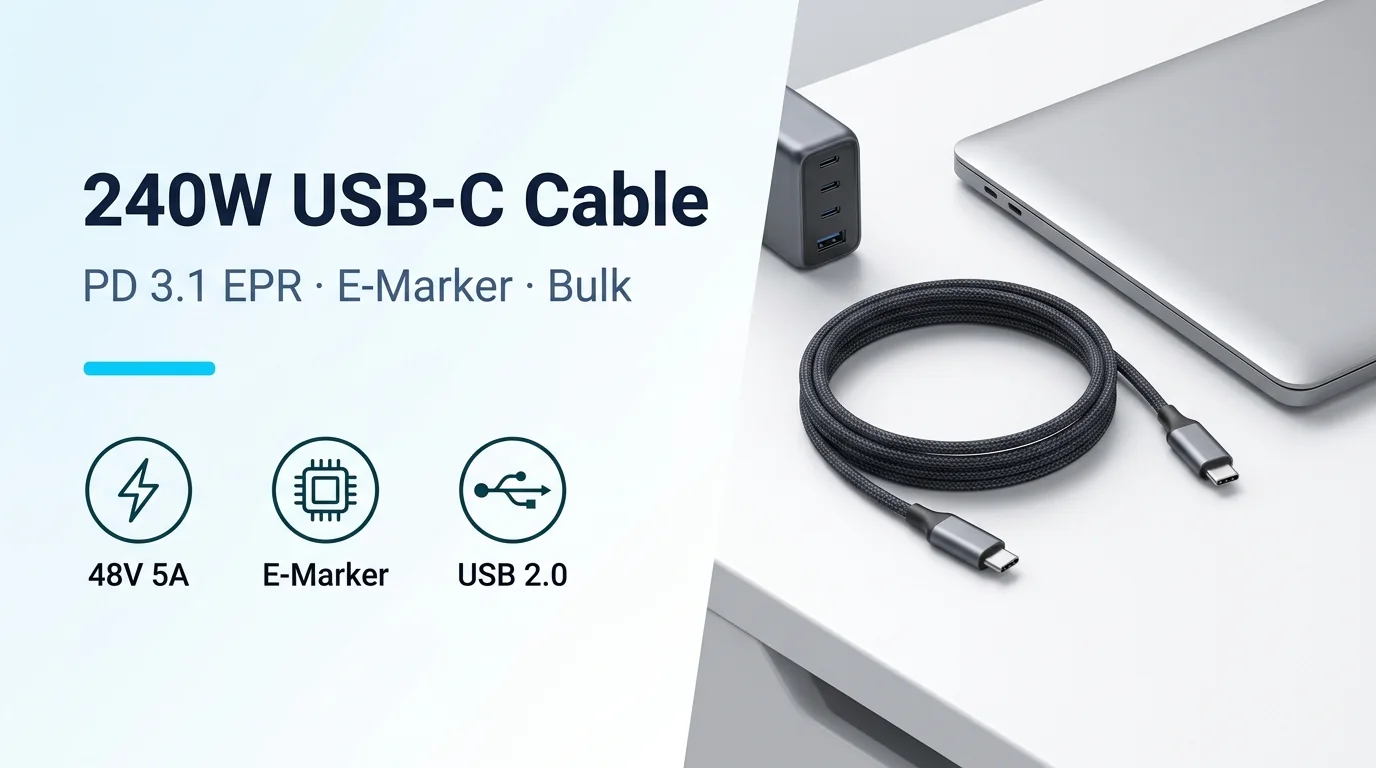
Specifying a high-wattage USB-C cable for wholesale distribution, corporate workstation bundles, or retail accessory programs requires separating three independent technical variables before issuing a purchase order: Extended Power Range voltage negotiation, electronically marked plug signaling, and physical data or video wire implementation. When preparing an inquiry through the Anker USB-C cable wholesale hub or reviewing our Anker wholesale buying guides, procurement teams should verify each model reference, cable length, and outer jacket specification as a distinct line item.
Announced in 2021, the USB PD Revision 3.1 specification enables delivering up to 240W of power over a full featured USB Type-C cable and connector, and the USB Type-C specification was updated to Release 2.1 to define 240W cable requirements. Prior to the USB PD Revision 3.1 update, USB PD was limited to 100W using a solution based on 20V using USB Type-C cables rated at 5A.
| Procurement checkpoint | Specification field to lock on the RFQ | Purchasing mistake prevented |
|---|---|---|
| Power delivery range and voltage tier | Standard Power Range ceiling versus Extended Power Range fixed and adjustable voltage profiles | Prevents pairing a passive or lower-tier cable with high-voltage workstation chargers |
| Data transfer and video signaling lanes | Hi-Speed charging-only wiring versus full-featured SuperSpeed and DisplayPort Alt-Mode lanes | Prevents approving a charging-only cable for external monitor docking or rapid storage backups |
| E-Marker transponder and overmold logo | Embedded plug electronics, VCONN pull-down detection, and certified power rating markings | Prevents accepting unmarked passive assemblies that cap charging current at baseline levels |
| Jacket construction and bend durability | Exact Anker model code for bio-based nylon, recycled nylon, or graphene-silicone sheath | Prevents generalizing laboratory bend-lifespan or tensile ratings across different cable families |
| Per-SKU length, color, and carton separation | Individual RFQ line for each model, length, and finish with explicit carton packing rules | Prevents unapproved length substitutions or mixed-length master cartons at warehouse receiving |
Extended Power Range Voltage Tiers vs. Legacy Standard Power Range#
Buyers transitioning from our Standard Power Range cable verification guide to Extended Power Range accessories should audit how source ports, cables, and connector contacts scale voltage rather than current:
- From USB 2.0 through USB PD 3.0, without USB PD a port can support up to 5 V at 3 A (15 W) with USB Type-C alone, whereas with USB PD it can support up to 20 V at 5 A (100 W) within the USB Type-C ecosystem.
- A passive USB Type-C cable does not have embedded powered electronics, must minimally support USB2.0, and can support USB Power Delivery up to 60W of power.
- New 28V, 36V, and 48V fixed voltages enable up to 140W, 180W and 240W power levels, respectively.
- An adjustable voltage supply mode allows the device being powered an ability to request intermediate voltages between 15V and up to the maximum available fixed voltage of the charger.
End-to-end high-voltage power delivery also depends on connector insulation ratings and power supply converter stages:
- GCT USB Type-C 4.0 Gen 3 connectors feature a stainless steel metallic shell, 48VDC voltage rating, 5A current rating, 100mΩ minimum insulation resistance, 20,000 cycles durability, and a 25 to 85 operating temperature range.
- The Renesas / Dialog EBC10293 240W PD3.2 EPR Design Board is designed to evaluate the built in RRW11011, RRW40120, RRW43110, and RRW30120 converters and achieves 96 efficiency at 48V 5A 230VAC and 95.3 115VAC with a USB PD 3.2 5V solution with standby 45mW.
Why a High Wattage Rating Does Not Grant SuperSpeed Data or Video Output#
A recurring procurement error in the Anker cable wholesale category is assuming that a higher charging wattage automatically includes high-speed data transfer or external monitor video support:
- USB Type-C is not USB 3.2, USB4, or USB Power Delivery; USB Power Delivery is a protocol/hardware solution that increases USB power capabilities up to 240W, and device manufacturers can choose whether to support USB Power Delivery, USB4, and/or USB 3.2.
- A USB 2.0 Type-C to USB 2.0 Type-C cable only supports USB 2.0 data operation and can support USB Power Delivery, and the cable does not support or include USB 3.2, USB4, or Alt-Mode capabilities.
- A USB 2.0 Type-C cable physically cannot support USB 3.2 or USB4 signals because TX/RX and AltMode (SBU) signals are not implemented, and a USB 3.2 or USB4 host/device used with a USB 2.0 Type-C cable will perform at the slower USB 2.0 speed.
- The USB Type-C connector has 24 pins arranged in a mirrored configuration, with 6 differential pairs in a full-featured cable assembly and 4 pins that serve functions new to USB: CC1, CC2, SBU1, and SBU2.
- Silkland's USB-C cable guide notes that buyers who want USB 3.2, USB4, or Thunderbolt 4 speeds should know a USB 2.0 cable maxes out at 480Mbps and should check whether the cable supports 10Gbps, 20Gbps, 40Gbps, or 80Gbps data transfer.
Compliance and overmold marking guidelines explain how certified charging cables identify wattage without printing baseline data rates on the connector boot:
- In addition to passing USB-IF compliance testing and inclusion on the Integrators List, companies wishing to use certified USB logos must have a current USB-IF Trademark License Agreement on file, with USB Power Delivery covered by adopters agreements for USB 2.0, USB 3.0, or USB4.
- All USB-C to USB-C cables are required to use the USB-IF approved cable logo embossed or printed on the overmold to pass the USB-IF Compliance Program; for example, a USB 20Gbps cable supporting 20V at 3A must be marked with the Combined Performance and Power 20Gbps/60W logo.
- While USB 2.0 Type-C 240W and 60W cables deliver data at up to 480Mbps, this data performance capability is not required to be included on the cable and is not reflected in the charging logos, and all cables must be labeled with the correct markings prior to submission for compliance testing.
- The USB 2.0 Type-C Cable Power Rating Logo (240W or 60W) must be used solely in conjunction with a USB 2.0 Type-C cable that has passed the USB-IF Test Procedure for USB Power Delivery 3.2 Standard Power Range and Hi-Speed USB Type-C cables and been posted on the USB-IF Integrators List.
- For the USB Type-C Cable Combined Logo on a cable overmold, the minimum size of the largest dimension is 0.25 inches (6.35mm), and a licensee may omit the ® symbol when printing or engraving on the cable overmold where location and size do not allow the symbol to have a maximum dimension of 15mm or more.
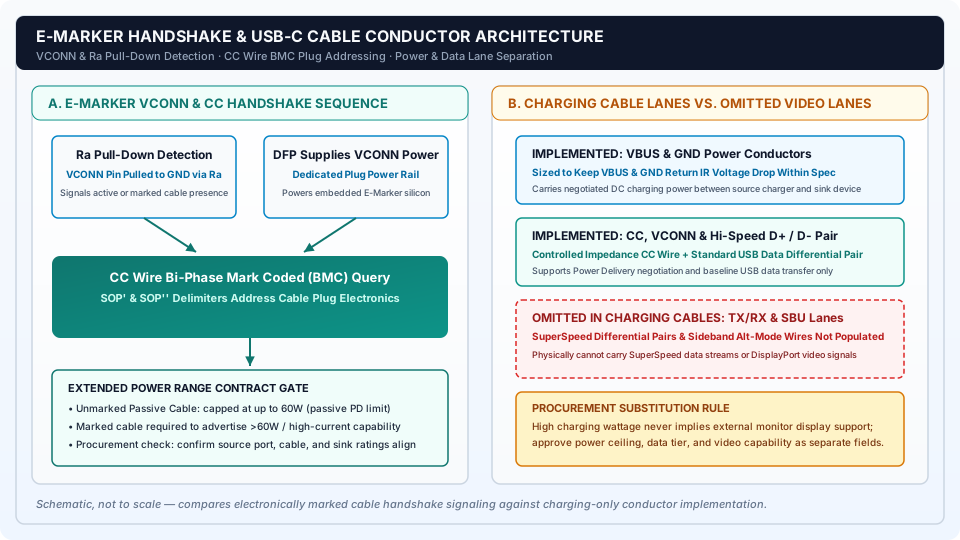
Schematic, not to scale: after Ra detection and VCONN power-up, ports negotiate high-power contracts over the CC wire via BMC (with e-marker plug addressing), while charging-only assemblies omit SuperSpeed TX/RX and SBU video lanes.
E-Marker Chip Verification, VCONN Supply, and Electrical Limits#
- In a USB Type-C cable, the unused CC pin is left floating on a passive cable or pulled down to ground with Ra on a passive electronically marked or active cable, and VCONN is required for all applications that support USB 3.1 speeds or power delivery higher than 3 A.
- An electronically marked cable has embedded electronics that can communicate with USB ports via USB Power Delivery 2.0 BMC protocol, may be powered from VCONN or VBUS drawing up to 70mW of total power, and is mandatory for all USB3.1 compatible USB Type-C cables and any cable capable of exceeding 60W of power carrying capability (such as a 100W Power Delivery cable).
- A managed active cable is an electronically marked cable that also has powered USB data reconditioning circuitry, and may be powered from the VCONN supply or directly from VBUS drawing up to 1.0W of total power.
- An active cable must connect an Ra pull-down resistor from the VCONN pin to GND, and the Ra resistor may range from 800Ω to 1.2kΩ.
- VCONN is a 5V (4.75V - 5.5V allowable range) 1.0W power supply sourced by the DFP by default to power circuits within the plug needed to implement electronically marked cables and VCONN-powered accessories.
- USB Power Delivery communication occurs over the CC wire using 32-bit 4b/5b encoded Bi-phase mark coded (BMC) messages at a 300k Baud rate with CRC32 error detection, using SOP for DFP to DFP messaging and SOP’ and SOP’’ for DFP to active cable plug messaging.
- The USB Type-C cable must minimally support 10,000 mating cycles, and wires must be sized to maintain ~50Ω impedance on the CC and SBU1/SBU2 wires, a maximum IR drop of 250mV on GND return, and a maximum IR drop of 500mV on VBUS.
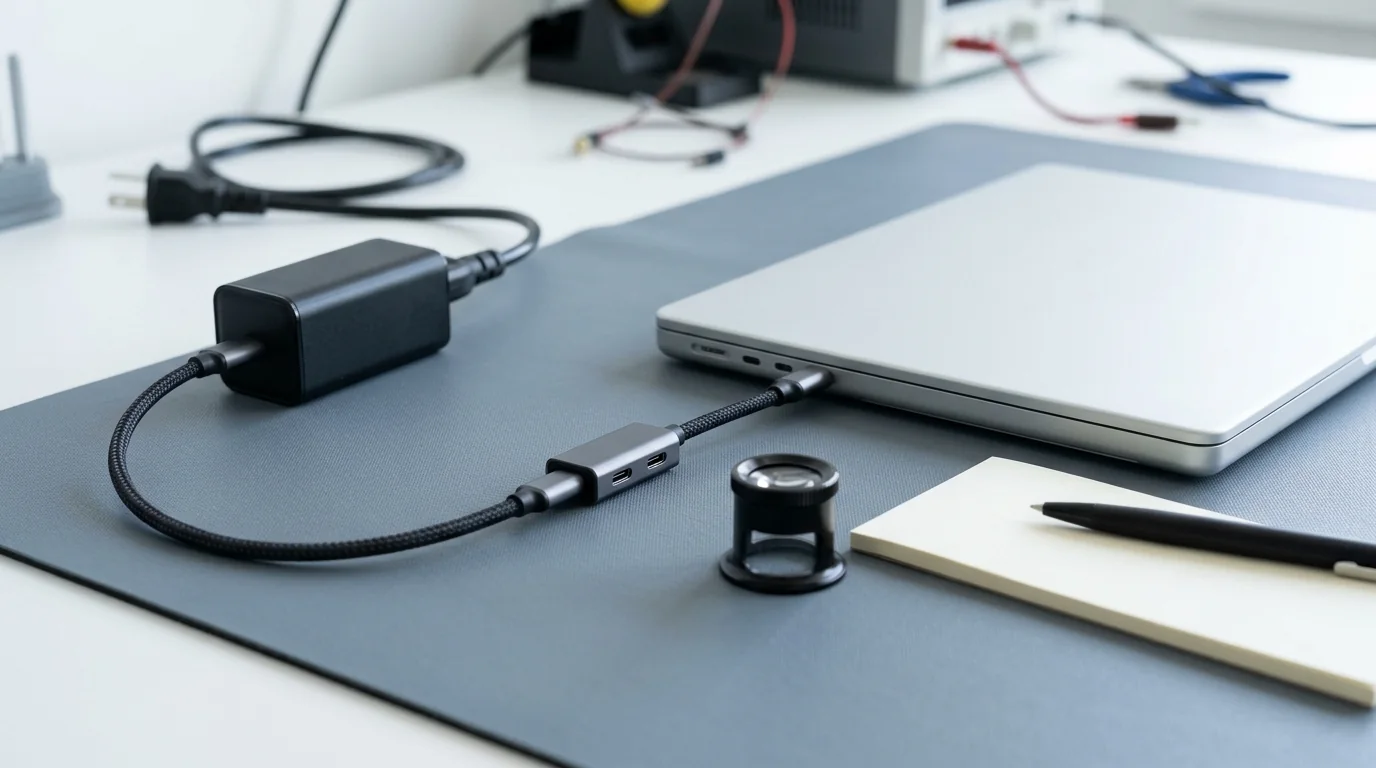
Pre-shipment verification bench: confirm the exact model specification sheet and E-Marker power descriptor handshake across the charger, cable, and sink device.
Comparing Anker High-Wattage Cable Models: Bio-Braided, Upcycled Nylon, and Silicone#
Rather than treating all braided or soft-touch cables as interchangeable, buyers reviewing the Anker bio-braided USB-C cable reference page should keep each model's outer jacket composition, bend-lifespan rating, and retail reference strictly separate:
- On AnkerWholesale.com, Model A80E6 (Anker 543 bio-braided USB-C to USB-C cable family, catalog facts checked 2026-10-07) lists Connector USB-C to USB-C, Maximum charging power Up to 240W, Data standard USB 2.0 with no media display, Manufacturer-listed lengths 3 ft, 6 ft, 10 ft, Bio-braided nylon exterior, New factory-sealed condition, and an accessory MOQ of 20 units per exact length-and-color combination.
- Anker Model A80E6 has a cable body and connector casing exterior constructed with bio-based nylon, packaging made of 100% recyclable paper printed with soy ink, is tested to withstand up to 20,000 bends, and supports up to 240W charging when paired with a 240W wall charger.
- Anker's product notes for Model A80E6 state that the cable does not support media display, only works with USB-C chargers, and is not compatible with USB-A wall chargers.
- For Anker SKU A80E6011 (GTIN 194644113971), 46% of the exterior of the cable body and the connector casing is made from bio-based nylon.
- On Anker EU, the Anker 543 USB-C to USB-C Cable (3 ft / 6 ft Bio-Braided) lists an offer price of 20.99 EUR and SoldOut availability status.
Anker's upcycled-braided Extended Power Range families carry different recycled nylon constructions and bend-test ratings:
- On Anker US, the Anker Prime USB-C to USB-C Cable (240W, Upcycled-Braided, 3 ft / 6 ft) is priced at $29.99 retail with an automatic checkout bulk discount of $18.77 each for 10+ pcs.
- Anker Model A88E2 (Anker Prime USB-C to USB-C Cable, 3 ft, 240W, Upcycled-Braided) is made from post-consumer recycled nylon, operates in temperatures from -40°F to 176°F, is designed to withstand over 300,000 bends (100 Years of Unmatched Bend Durability) and support up to 220 lbs, and is a USB-IF certified USB 2.0 cable supporting a 480 Mbps transfer rate that does not support screen mirroring.
- Anker SKU A88E2011 (GTIN 194644054618) lists 240W charging capability that can boost a 16-inch MacBook Pro (M3 Pro) to 50% in 26 minutes.
- On Anker US, the Anker USB-C to USB-C Cable (240W, Upcycled-Braided, 3 ft / 6 ft / 10 ft) is priced at $19.99 retail with a bulk discount of $12.99 each for 10+ pcs and specifies a 240W MAX Output and a Bend Lifespan of over 30,000.
- Anker Model A82E2 specifies a bend lifespan over 30,000, meets USB-IF specification, includes 24-Month Coverage, comes in 5 vibrant finishes with soft PCR braided construction, offers 480 Mbps data transfer, does not support screen mirroring, includes a silicone cable organizer, and uses recycled nylon and plastic-free packaging.
- Anker SKU A82E2011 (GTIN 194644039882) is a 240W USB-IF certified cable stated to charge a 16-inch MacBook Pro (2023) to 50% in 28 minutes.
Comparing Standard Power Range nylon and graphene-silicone models alongside peer market references further illustrates how bend ratings, tensile limits, and over-temperature features vary by exact SKU:
- On Anker US, the New Nylon USB-C to USB-C 100W Cable (10 ft) is priced at $9.99 retail with an automatic checkout bulk discount of $7.42 each for 10+ pcs.
- Anker Model A8758 (New Nylon USB-C to USB-C 100W Cable, 10 ft) has a max output of 100W, is proven in laboratory settings to withstand up to 12,000 bends, transfers data at speeds of up to 480 Mbps, and is built with an e-Marker chip in each end of the cable to communicate power requirements with connected devices.
- Anker Model A8758 does not support video output, measures 118.11 x 0.35 x 0.92 inches, weighs 3.68 ounces, and lists Declaration of Conformity A8758-DOC dated 2021-05-11.
- Anker Model A8552/3 (Anker 643 USB-C to USB-C Cable) features a triple-layered system of copper wires, flexible graphene, and silicone with a tensile strength of 220 lbs (100 kg), a 25,000-bend lifespan, an included silicone strap, 8 fresh finishes, up to 100W Power Delivery fast charging in its overview description, and does not support media display.
- Belkin's BoostCharge 240W USB-C cable specifies fast charging up to 240W, dual E-marker chips with OTP (Over-Temperature Protection), a double-braided nylon cable design tested to survive 30,000 bends, USB-IF certification compliant with USB 2.0, 3.3 ft./1m or 6.6 ft./2m lengths, 100% plastic-free packaging, and a 2-year warranty.
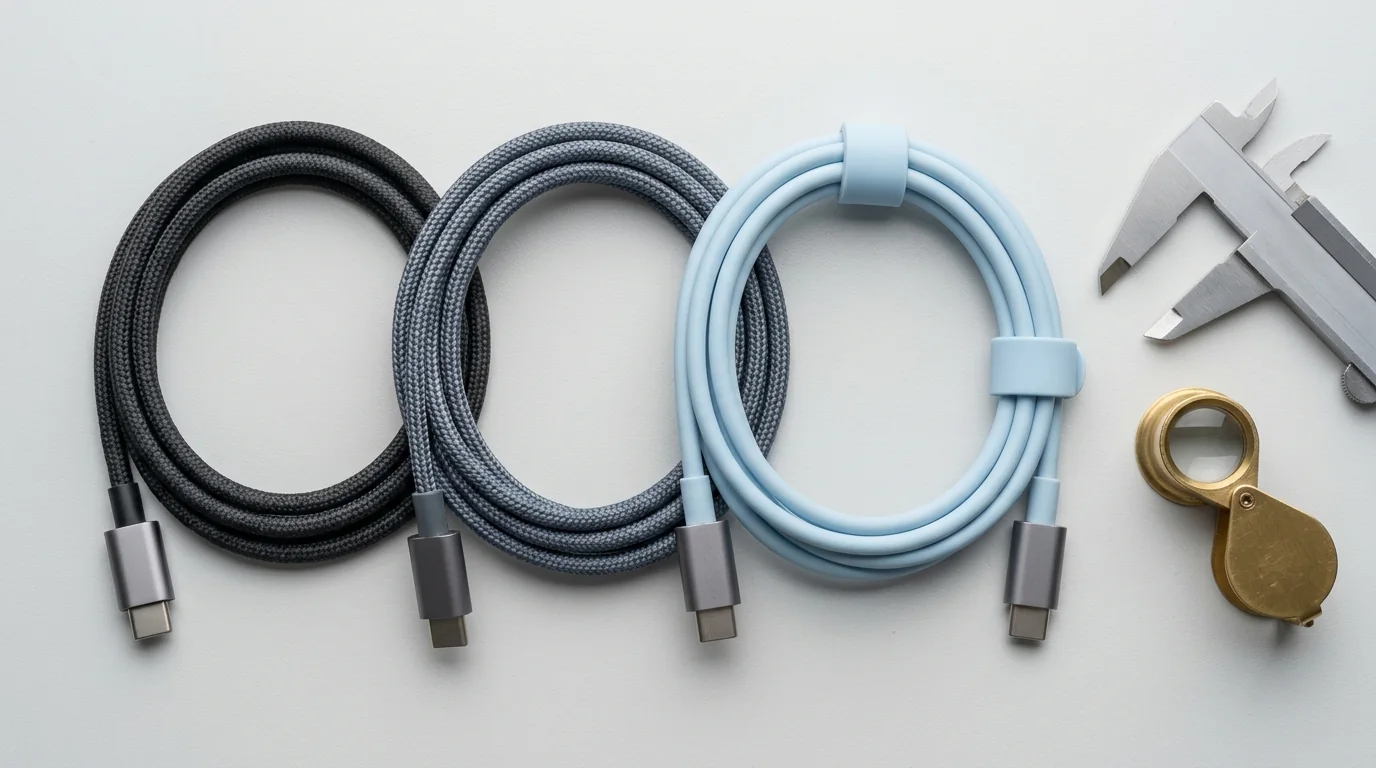
Outer jacket comparison: bio-braided nylon, upcycled post-consumer recycled nylon, and graphene-silicone cables carry distinct bend-lifespan and tensile specifications that must be locked by exact model code.
Wholesale RFQ Line Structure, Charger Pairing, and Commercial Terms#
When bundling cables with desktop chargers or high-capacity power banks using our single-port PD contract guide, Anker laptop power bank compatibility guide, and mixed-SKU Anker wholesale order guide, buyers should verify port ceilings and per-SKU accessory minimums on our wholesale pricing page and company verification profile:
- AnkerWholesale.com links Model A80E6 to related references A2148 (Anker 737 Charger GaNPrime 120W, 100W max single-port output, 2 × USB-C, 1 × USB-A), A110A (Anker Prime Power Bank 26K, 300W, 26,250mAh, 140W max single-port output), and A1654 (Anker MagGo Power Bank 10K, 10,000mAh / 38.5Wh, 15W wireless output, up to 27W USB-C output).
- On AnkerWholesale.com, each length and color of A80E6 stays on its own RFQ line (for example 0.9 m black qty 40 or 1.8 m white qty 20), and buyers should specify not to mix lengths in one carton unless confirmed and not to substitute A80E6 for USB-C to USB-A lines.
- AnkerWholesale.com starting commercial terms require 10 units in total for power banks, chargers, and hubs (with no per-SKU device minimum), 20 units per SKU for cables and small accessories, a total order value that must exceed US$2,000 (an order of exactly US$2,000 does not meet the threshold), payment by T/T or L/C, and handoff at a nominated address in mainland China or Hong Kong or by buyer-arranged UPS/DHL pickup.
- Anker Wholesale is operated by GuangZhou Duohuo Technology Co., Ltd at Courtyard, No. 358, Zhongshan Avenue, Tianhe District, Guangzhou, Guangdong, CN, with sales contact email jacklau@ankerwholesale.com and telephone/WhatsApp +8613790027900.

Warehouse SKU line separation: keep each cable model, length, and color variant on its own purchase order line and confirm master carton packing before dispatch.
Frequently Asked Questions#
How does the Extended Power Range specification increase USB Type-C cable power delivery beyond legacy limits?
Announced in 2021, the USB PD Revision 3.1 specification enables delivering up to 240W of power over a full featured USB Type-C cable and connector, and the USB Type-C specification was updated to Release 2.1 to define 240W cable requirements.
Why does a high-wattage USB Type-C charging cable fail to support external monitor video or SuperSpeed data?
A USB 2.0 Type-C cable physically cannot support USB 3.2 or USB4 signals because TX/RX and AltMode (SBU) signals are not implemented, and a USB 3.2 or USB4 host/device used with a USB 2.0 Type-C cable will perform at the slower USB 2.0 speed.
When is an electronically marked USB Type-C cable mandatory for power delivery and data applications?
An electronically marked cable has embedded electronics that can communicate with USB ports via USB Power Delivery 2.0 BMC protocol, may be powered from VCONN or VBUS drawing up to 70mW of total power, and is mandatory for all USB3.1 compatible USB Type-C cables and any cable capable of exceeding 60W of power carrying capability (such as a 100W Power Delivery cable).
What minimum order quantities and payment terms apply when sourcing Anker cables and accessories in bulk?
AnkerWholesale.com starting commercial terms require 10 units in total for power banks, chargers, and hubs (with no per-SKU device minimum), 20 units per SKU for cables and small accessories, a total order value that must exceed US$2,000 (an order of exactly US$2,000 does not meet the threshold), payment by T/T or L/C, and handoff at a nominated address in mainland China or Hong Kong or by buyer-arranged UPS/DHL pickup.
Sources#
- USB Implementers Forum (USB-IF) — USB Charger (USB Power Delivery) Specification Overview
- USB Implementers Forum (USB-IF) — USB Type-C Cable and Connector Language and Product/Packaging Guidelines
- USB Implementers Forum (USB-IF) — USB Type-C Cable Logo Usage Guidelines
- Texas Instruments — A Primer on USB Type-C and USB Power Delivery Applications and Requirements
- Microchip Technology — Introduction to USB Type-C Application Note
- Electronic Design and Mouser Electronics — High-Power USB Type-C Connector and Extended Power Range Design Board Specifications
- Anker Official Product Pages — Bio-Braided, Upcycled-Braided, Nylon, and Silicone USB-C Cable Technical Specifications
- Belkin — BoostCharge USB-C to USB-C Cable Specification Reference
- Silkland — USB-C Cable Power Delivery and Data Transfer Speed Guide
- GuangZhou Duohuo Technology Co., Ltd — Anker Wholesale Catalog, USB-C Cable Sourcing Hub, and Commercial Terms