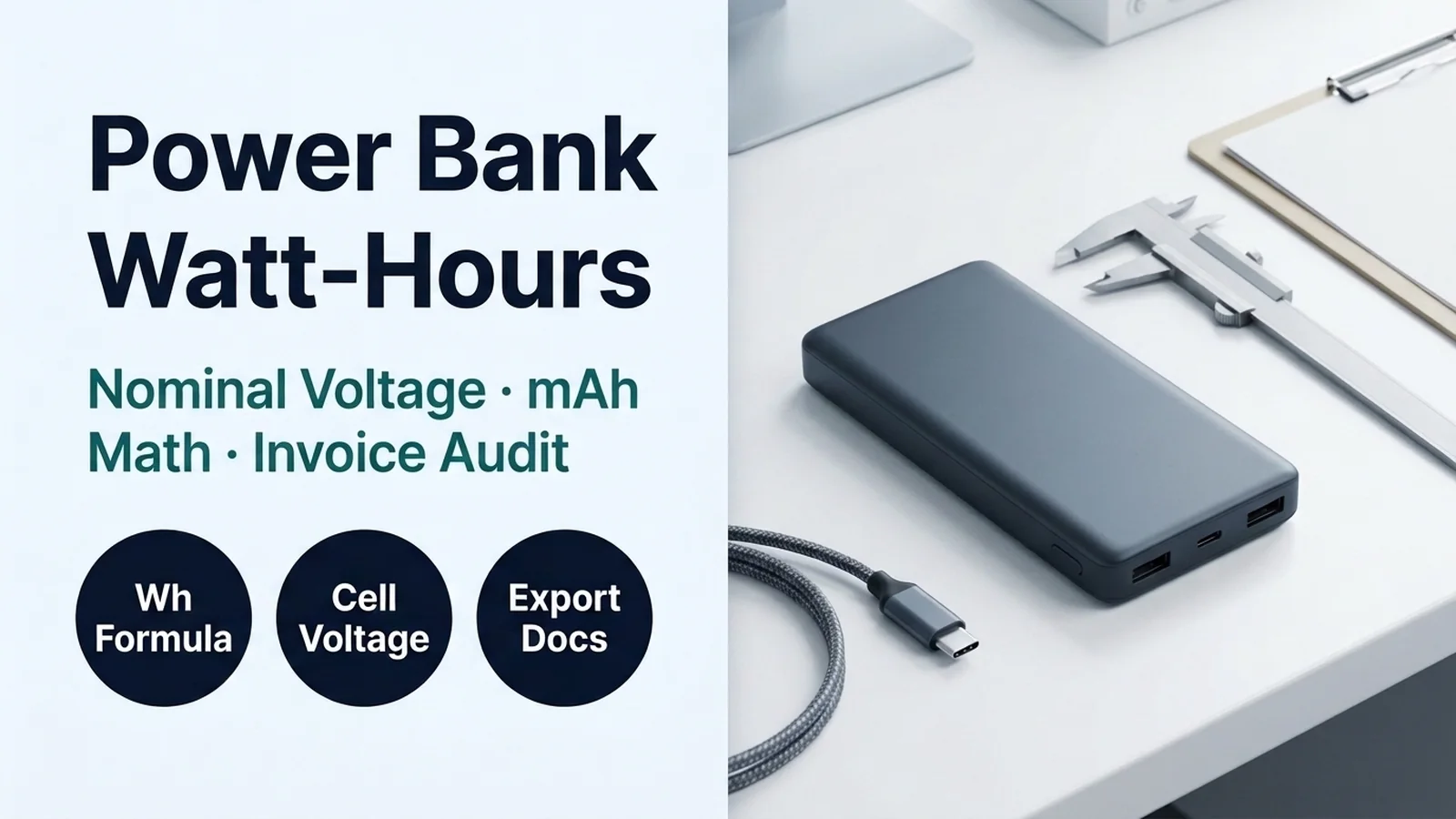
Preparing a commercial invoice, packing list, or freight booking for a bulk portable battery shipment starts with one accounting rule: calculate stored battery energy from the internal cell or pack charge capacity and nominal voltage, never from external USB port output profiles. When sourcing through the Anker power bank wholesale catalog, aligning the printed outer-case energy mark, the supplier test summary, and the customs invoice line prevents freight forwarder holds and documentary mismatches.
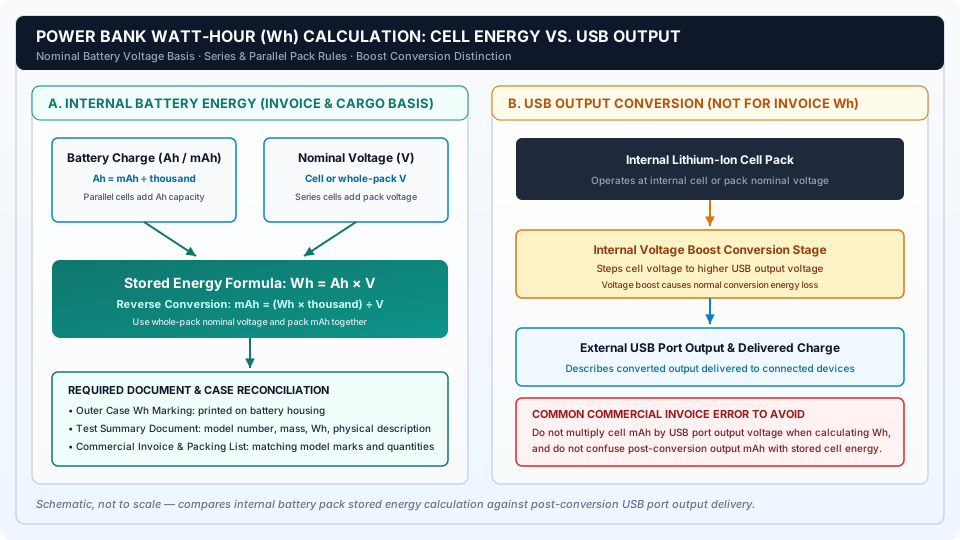
Under federal hazardous materials definitions, Watt-hour (Wh) means a unit of energy equivalent to one watt (1 W) of work acting for one hour (1 h) of time. The Watt-hour rating of a lithium-ion cell or battery is determined by multiplying the rated capacity of a cell or battery in ampere-hours by its nominal voltage: Watt-hour (Wh) = ampere-hour (Ah) × volts (V). Expressed in Wh, the Watt-hour rating of a lithium cell or battery is calculated by multiplying the rated capacity in ampere-hours by the nominal voltage.
| Verification checkpoint | Data field to record on export paperwork | Documentation error prevented |
|---|---|---|
| Internal battery charge basis | Cell or whole-pack charge capacity in Ah or mAh paired with nominal battery voltage | Prevents substituting post-conversion packaging output figures into stored energy math |
| Voltage selection check | Nominal cell or battery pack voltage printed on the housing or model specification sheet | Prevents multiplying mAh by stepped-up USB port delivery voltages on customs invoices |
| Multi-cell pack topology check | Whole-pack nominal voltage and whole-pack mAh capacity taken from the same level | Prevents mixing pack-level charge capacity with a single-cell nominal voltage |
| Outer case and test summary match | Physical outer-case Wh marking, exact model code, unit mass, and physical description | Prevents discrepancies between the battery test summary, carton stencil, and invoice line |
| Customs invoice and packing list alignment | Detailed merchandise description, model marks, package marks, and per-carton item counts | Prevents customs entry queries when package contents or model symbols differ across documents |
Core Watt-Hour Equations and Nominal Cell Voltage Sensitivity#
Logistics teams and customs brokers preparing a power bank wholesale RFQ use the same core equation across air, ocean, and ground transport filings:
- The Watt-hours of the battery can be calculated by multiplying the nominal voltage (V) and capacity in ampere-hours (Ah): Wh = V x Ah.
- If only the milliampere-hours (mAh) are marked on the battery, divide that number by 1000 to get ampere-hours (Ah), for example 4400 mAh / 1000 = 4.4 Ah.
- For milliamp hours (mAh), divide mAh by 1000 to get to Ah and then multiply by the V.
- In the worked example, a 12-volt battery rated to 8 Ah is rated at 96 Wh (12 x 8 = 96).
- To calculate Wh to mAh, multiply the watt-hours by 1,000 and divide by the battery's nominal voltage: mAh = (Wh × 1,000) ÷ V; for the reverse calculation, use Wh = (mAh × V) ÷ 1,000.
Separating electrical charge from stored energy explains why two power banks with identical mAh headlines can carry different Wh values on a commercial invoice:
- Watt-hours measure stored energy: a 50Wh battery could theoretically supply 50W for one hour or 25W for two hours.
- Milliamp-hours measure electrical charge, and two 10,000mAh batteries can store different amounts of energy if their nominal voltages differ.
- Voltage connects electrical charge with energy: a 10,000mAh battery at 7.4V stores twice the energy of one at 3.7V.
- Nominal voltage describes the battery cells or pack, whereas USB output voltage describes what the power bank delivers after conversion; a unit may use cells around 3.6V to 3.8V.
At a nominal cell voltage of 3.7V, common portable battery capacities convert as follows:
- For a 5,000mAh battery, 5,000 × 3.7 ÷ 1,000 equals 18.5Wh.
- For a 10,000mAh battery, 10,000 × 3.7 ÷ 1,000 equals 37Wh.
- For a 20,000mAh battery, 20,000 × 3.7 ÷ 1,000 equals 74Wh.
- For a 25,000mAh battery, 25,000 × 3.7 ÷ 1,000 equals 92.5Wh.
- At 3.7V, 100Wh equals approximately 27,027mAh ((100 × 1,000) ÷ 3.7 ≈ 27,027mAh), and these results assume 3.7V, whereas at 5V, 100Wh would equal 20,000mAh.
- In a voltage sensitivity comparison, 27,000 × 3.7 ÷ 1,000 = 99.9 Wh, whereas 27,000 × 3.85 ÷ 1,000 = 103.95 Wh.
Why USB Output Voltage and Packaged Output Capacity Corrupt Commercial Invoices#
A frequent clerical mistake on import invoices occurs when an accounting clerk multiplies the cell charge capacity in mAh by the external USB port voltage, or mistakes the stepped-up device delivery figure for internal battery energy:
- When converting mAh to watt-hours, do not use the USB output voltage simply because the port says 5V or 9V; use the nominal voltage associated with the rated mAh capacity.
- In a hypothetical worked example, 10,000 mAh × 3.7 V ÷ 1,000 = 37 Wh, whereas using a 5 V USB output rating for that same capacity would produce 50 Wh and misstate the battery energy.
- To charge devices, a power bank must convert its 3.7V cell voltage to 5V output (or higher), and power bank circuit loss operates at about 80 - 85% efficiency.
- Assuming 82% conversion efficiency, 74 Wh × 0.82 = 60.7 Wh, and converted to a 5 V output equivalent, 60.7 Wh ÷ 5 V ≈ 12,140 mAh—an illustrative figure from this efficiency assumption, not a claim that packaging universally prints 12,140 mAh.
- For Anker Model A110A, conversion and path losses mean the milliamp-hour figure delivered at a higher output voltage is not the same quantity as the cell's 26,250 mAh charge rating; published device examples on the order of about 15,200 mAh at the load are charge-throughput comparisons, not a second Wh energy-loss band stacked on top of the 80–85% efficiency model above.
Multi-Cell Pack Topologies and Anker Model Specification Audit#
Wholesale buyers auditing multi-cell laptop power banks and slim magnetic packs across the Anker MagGo comparison guide should distinguish single-cell geometry from series and parallel battery assemblies:
- A cell is a single encased electrochemical unit, whereas a battery is two or more cells electrically connected, and a single cell battery is considered a cell and not a battery for the purposes of the limitations set out in the DGR.
- When cells are connected in series, the voltage of the battery increases but the capacity in ampere-hours (Ah) does not change.
- By contrast, when cells are connected in parallel, the capacity in ampere-hours of the battery (Ah) increases but the voltage stays the same.
- Multi-cell packs can connect cells in series, parallel or both; use the nominal voltage and mAh rating stated for the whole pack, and do not combine pack-level capacity with a single cell's voltage.
Comparing published Anker specifications illustrates how different models report capacity, nominal voltage, Watt-hours, and port output profiles:
- For the Anker Prime Power Bank, with 26,250mAh (99.75Wh) of TSA-approved capacity and 300W total output across three ports, it provides reliable backup power during outages.
- Single-port output ratings are USB-C 5V⎓3A / 9V⎓3A / 12V⎓3A / 15V⎓3A / 20V⎓5A / 28V⎓5A (140W Max) and USB-A 5V⎓3A / 9V⎓2A / 10V⎓2.25A / 12V⎓1.5A (22.5W Max).
- Dimensions are 6.3 × 1.5 × 2.5 in (159.9 × 38 × 62.7 mm) and weight is 1.32 lb (600 g).
- On the EU Declaration of Conformity, the Name of the Manufacturer is Anker Innovations Limited in Hong Kong for the Anker Prime Power Bank (26K, 300W) under Trademark Anker and Model No. A110A.
- The declaration lists IEC 62133-2:2017 and IEC 62133-2:2017/AMD1:2021 along with Directives 2014/53/EU, 2014/30/EU, 2011/65/EU & (EU)2015/863, (EU) 2023/1542 & 2006/66/EC.
- The Anker Prime Power Bank (20K, 220W) has a 20,100mAh capacity (72.36Wh), up to 220W total output across multiple ports, up to 140W charging from a single USB-C port, and up to 100W USB-C input.
- For the Anker MagGo Power Bank, Total Capacity is 10,000mAh and Battery Capacity is 10000mAh 3.85Vdc/38.5Wh.
- The specification lists 1 USB-C port with Total Input USB-C Input 5V⎓3A / 9V⎓2.22A, Total Output USB-C Output 5V⎓3A / 9V⎓3A, Wireless Output 15W Max, and Dimensions 107.3 × 68.8 × 19.8 mm.
- For the Anker MagGo Slim Power Bank, Total Capacity is 10,000mAh, with USB-C Input (30W Max) at 5V⎓3A / 9V⎓3A / 15V⎓2A and Total Output USB-C Output (30W Max) at 5V⎓3A / 9V⎓3A / 12V⎓2.5A / 15V⎓2A / 20V⎓1.5A.
- Total Output combines USB-C 5V⎓2.4A (12W Max) and Wireless 5W Max, while Dimensions are 4.09 × 2.78 × 0.58 in (104 × 70.6 × 14.7 mm) and Weight is 7.62 oz (215.9 g).
When a public retail specification page lists only total charge capacity in mAh and port output profiles without printing the cell nominal voltage or Watt-hour figure, procurement teams should inspect the physical outer-case marking and the model-matched test summary rather than guessing the cell voltage.

Reconciling Commercial Invoices, Packing Lists, Test Summaries, and Cargo Declarations#
While individual travelers consult our passenger airline power bank guide for cabin baggage rules, commercial wholesale shipments and vendor sample lots move under cargo dangerous goods and customs invoice rules:
- Passenger allowances apply provided they are for personal use by the passenger, and batteries carried for further sale or distribution (vendor samples, etc.) are prohibited.
- For the purposes of the guidance document and the IATA Dangerous Goods Regulations, power banks are to be classified as batteries and must be assigned to UN 3480, lithium ion batteries, or UN 3090, lithium metal batteries, as applicable.
- When a package contains only an AC adaptor or charger, or ancillary cables, and lithium-ion batteries, the package must be classified as UN 3480, Lithium ion batteries and packaged in accordance with PI 965.
- Under UN 3480 PI 965, cells > 20 Wh or batteries > 100 Wh fall under Section IA, whereas cells ≤ 20 Wh and batteries ≤ 100 Wh fall under Section IB.
- Passenger aircraft transport is forbidden (Pax A/C = Forbidden). Under UN 3480 / PI 965, the Cargo Aircraft Only package limit is 35 kg for Section IA and 10 kg for Section IB.
Federal hazardous materials regulations and international battery testing rules govern outer-case markings and test summary records across the distribution chain:
- Each lithium cell or battery must be of the type proven to meet the criteria in part III, sub-section 38.3 of the UN Manual of Tests and Criteria.
- Beginning May 10, 2024, each lithium ion battery must be marked with the Watt-hour rating on the outside case.
- Under 49 CFR § 173.185(c)(1)(i) smaller cell and battery exceptions, the Watt-hour (Wh) rating may not exceed 20 Wh for a lithium ion cell or 100 Wh for a lithium ion battery.
- Under 49 CFR § 173.185(c)(1)(iv), for transportation by highway or rail only, the Watt-hour limits may be increased to 60 Wh for a lithium ion cell or 300 Wh for a lithium ion battery if the outer package is marked LITHIUM BATTERIES—FORBIDDEN FOR TRANSPORT ABOARD AIRCRAFT AND VESSEL.
- Manufacturers and subsequent distributors of cells or batteries manufactured after 30 June 2003 must make available the test summary specified in sub-section 38.3, paragraph 38.3.5.
- The description of the cell or battery includes lithium ion, or lithium metal, or sodium ion, cell or battery; mass; Watt-hour rating, or lithium content; physical description of the cell/battery; and model numbers.
- A physical description is intended to provide a check, and the invoice description or marketing name of the product as the physical description could be used on the test summary.
- For rechargeable cells and batteries, a change in Watt-hours of more than 20% or an increase in voltage of more than 20% shall be considered a new type.
Customs entry filings require the commercial invoice and package-level packing list to reflect the exact merchandise shipped:
- A commercial invoice contains a detailed description of the merchandise, including the name by which each item is known, the grade or quality, and the marks, numbers, and symbols under which sold by the seller or manufacturer to the trade in the country of exportation, together with the marks and numbers of the packages in which the merchandise is packed.
- The invoice states the quantities in the weights and measures of the country or place from which the merchandise is shipped, or in the weights and measures of the United States, and the purchase price of each item in the currency of the purchase, if the merchandise is shipped in pursuance of a purchase or an agreement to purchase.
- For the packing list, each invoice must state in adequate detail what merchandise is contained in each individual package.
- A commercial invoice is a required document for the export and import clearance process and may include the Harmonized System (HS) code, which can speed up the export clearance process.
When consolidating a wholesale order through the Anker power bank wholesale catalog, buyers can review our published wholesale pricing terms and company verification profile before locking carton quantities:
- On Anker Wholesale (/pricing), power banks, chargers, and hubs start from 10 units in total with no per-SKU device minimum, and total order value must exceed US$2,000.
- Payment is by T/T or L/C as confirmed in the RFQ, and handoff is at a nominated address in mainland China or Hong Kong, or via buyer-arranged UPS/DHL pickup.

Frequently Asked Questions#
How do you convert power bank milliamp-hours to Watt-hours for a commercial invoice?
To calculate Wh to mAh, multiply the watt-hours by 1,000 and divide by the battery's nominal voltage: mAh = (Wh × 1,000) ÷ V; for the reverse calculation, use Wh = (mAh × V) ÷ 1,000.
Why should importers never use the USB output port voltage when calculating power bank Watt-hours?
When converting mAh to watt-hours, do not use the USB output voltage simply because the port says 5V or 9V; use the nominal voltage associated with the rated mAh capacity.
How do series and parallel cell connections affect battery pack voltage and capacity in ampere-hours?
When cells are connected in series, the voltage of the battery increases but the capacity in ampere-hours (Ah) does not change. By contrast, when cells are connected in parallel, the capacity in ampere-hours of the battery (Ah) increases but the voltage stays the same.
What starting order quantities and payment terms apply when sourcing Anker power banks in bulk?
On Anker Wholesale (/pricing), power banks, chargers, and hubs start from 10 units in total with no per-SKU device minimum, and total order value must exceed US$2,000. Payment is by T/T or L/C as confirmed in the RFQ, and handoff is at a nominated address in mainland China or Hong Kong, or via buyer-arranged UPS/DHL pickup.
Sources#
- U.S. Department of Transportation and PHMSA (via Cornell Law School Legal Information Institute) — Federal Hazardous Materials Definitions and Lithium Battery Transport Rules
- International Air Transport Association (IATA) — Lithium Battery Guidance Document for Transport of Lithium Metal and Lithium Ion Batteries
- U.S. Federal Aviation Administration (FAA) — PackSafe Airline Passengers and Batteries Guidance
- U.S. Customs and Border Protection (via Cornell Law School Legal Information Institute) — Customs Commercial Invoice and Packing List Rules
- U.S. Department of Commerce and International Trade Administration (Trade.gov) — Commercial Invoice Export Clearance Guide
- Anker Official Technical Guide — Converting Battery Milliamp-Hours to Watt-Hours
- Anker Official Support Knowledge Base — Power Bank Conversion Efficiency and Packaged Capacity Guide
- Anker Official Product Pages and EU Declaration of Conformity — Anker Prime and Anker MagGo Power Bank Technical Specifications
- Hanke Global — Anker Wholesale Catalog, Passenger Travel Reference, and Procurement Terms