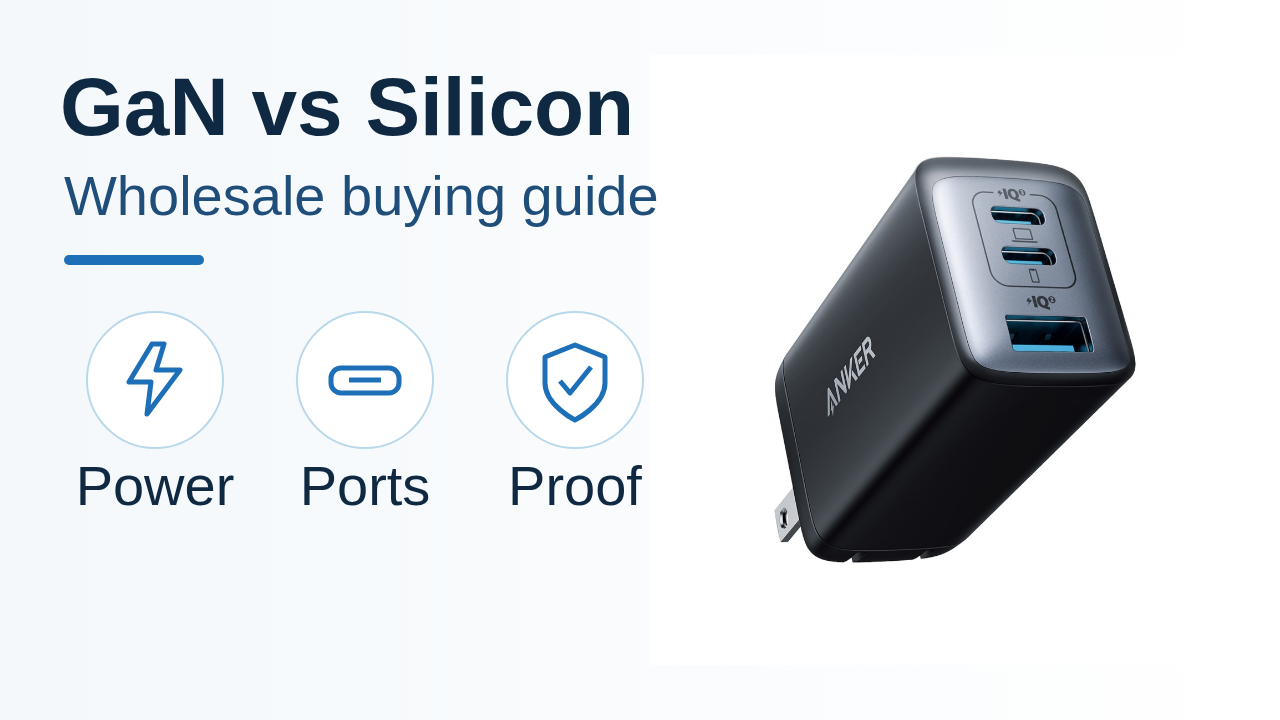
Choosing the wrong GaN charger by headline wattage can leave a laptop short of power when a second device connects. A GaN charger uses gallium nitride in its power-switching circuitry; compared with traditional silicon designs, it can enable a smaller, more efficient power converter, while the exact charger still determines charging compatibility and simultaneous output.
For wholesale buying, compare GaN and silicon chargers against the same device bundle, regional plug and evidence requirements. GaN describes a semiconductor technology. Anker GaNPrime describes a product technology family, and USB Power Delivery or PPS describes charging capabilities that need model-specific verification. Use the comparison below to decide whether compactness earns its place in your assortment, then check the port schedule and the documentation for the offered regional SKU.
| Input or item | Typical value or source | Why it matters |
|---|---|---|
| Device demand | Device maker’s charging specification and intended workload | Sets the required voltage/current profile and power |
| Simultaneous use | Named devices and the exact ports occupied | A total rating does not specify every port combination |
| Size and plug | Supplier dimensions and regional unit-label photos | Compact body, socket fit and destination plug are separate checks |
| Market evidence | Model-matched safety, FCC and EU documents as applicable | A GaN label establishes none of these |
What changes when a charger uses GaN instead of silicon?#
GaN can reduce switching losses and support higher switching frequencies, allowing designers to use smaller magnetic components. That creates an opportunity for higher power density, meaning more output power for a given enclosure volume. The transformer, cooling design, protection circuits and USB controller still affect the finished charger.
Texas Instruments’ GaN technology explanation supports this design mechanism. Its component and reference-design benefits do not establish a universal size reduction, efficiency or case temperature for every retail adapter. Compare finished-product dimensions and efficiency under the same output load and input voltage.
| Buying condition | GaN route | Silicon route | Dominant Failure Mode & Prevention |
|---|---|---|---|
| Compact laptop or travel bundle | Shortlist when documented size and required output fit the bundle | Keep as an option if it meets the same space and output requirements | Charger blocks adjacent sockets: check body dimensions, plug orientation and the actual socket layout |
| One device with modest demand | Judge any premium against useful space or efficiency gains | A documented compatible option can remain sufficient | Buying extra watts without the right protocol: match the device’s required voltage/current profile |
| Several devices together | Check the exact multiport schedule, including port-pair exceptions | Apply the same concurrent-output check | Laptop charging drops after connection: verify every intended port combination on a sample |
| Regional retail stock | Require the exact plug, model label and supporting documents | Require the same evidence | Wrong version or unmatched paperwork: reconcile quotation, unit and documents before acceptance |
A useful selection rule: if a documented silicon option meets your required output profiles and measured space allowance, the material name alone is no reason to replace it. Prioritize GaN when the offered model solves an actual size or power-density requirement and passes the remaining checks. Neither technology label proves that a charger is cool to touch or that a phone will charge faster.
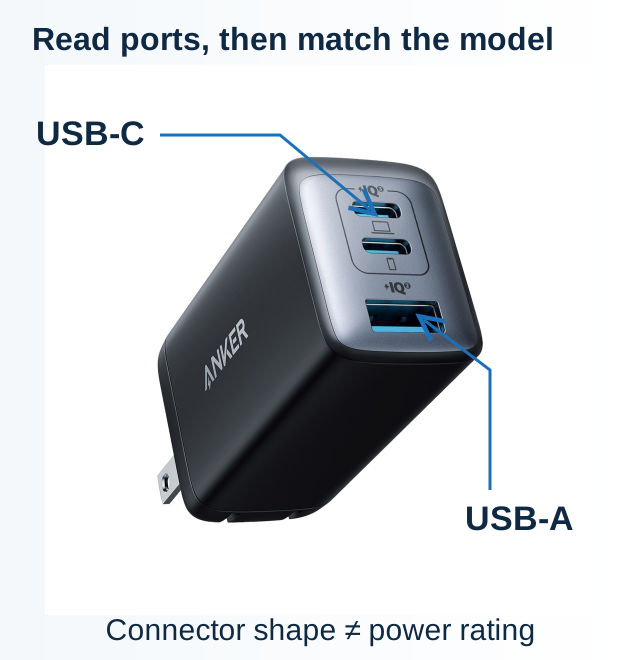
Identify the connector layout, then read the unit’s model label and matching output schedule. This hardware view does not identify the offered SKU or establish its port ratings.
How should buyers read Anker GaNPrime power allocation?#
Read the exact model’s output table before choosing a device bundle. Anker describes PowerIQ 4.0 on A2148 as detecting connected-device demand and adjusting power allocation. That behavior operates within the model’s limits; it does not give every connected port the full box rating.
The Anker A2148 support specification lists the following maxima for the Anker 737 Charger, GaNPrime 120W:
| A2148 connection | Published maximum | Buying implication |
|---|---|---|
| USB-C1 or USB-C2 alone | 100 W; up to 20 V × 5 A | A 120 W total rating is not a 120 W single-port rating |
| USB-A alone | 22.5 W | Check the device’s supported protocol as well as watts |
| C1 + C2, or C1 + USB-A | 120 W combined | Request the usable allocation for the intended devices |
| C2 + USB-A, leaving C1 unused | 24 W combined | This port pair cannot deliver a laptop-plus-phone budget above 24 W |
| C1 + C2 + USB-A | 120 W combined | The sum does not specify a guaranteed output on each port |
These are manufacturer specification baselines for A2148, not a specification for every GaNPrime charger. Check the proposed regional model and current manual. Anker’s A2148 feature description explains Dynamic Power Distribution; it does not replace the connection table.
Rule of thumb: if the required combined output exceeds 24 W, exclude A2148 from C2-plus-USB-A-only use. Check a connection using C1 against the documented allocation, or select another verified model. Start with a necessary power-budget check:
Required simultaneous output (W) = sum of the required device outputs (W).
Hypothetical worked example: 65 W laptop + 30 W phone = 95 W required. An assumed 90 W combined source falls short by 95 − 90 = 5 W. A source above 95 W still needs the right per-port profiles and allocation; the sum alone cannot prove compatibility. Do not subtract phone watts from a charger’s headline total and treat the remainder as guaranteed laptop output.
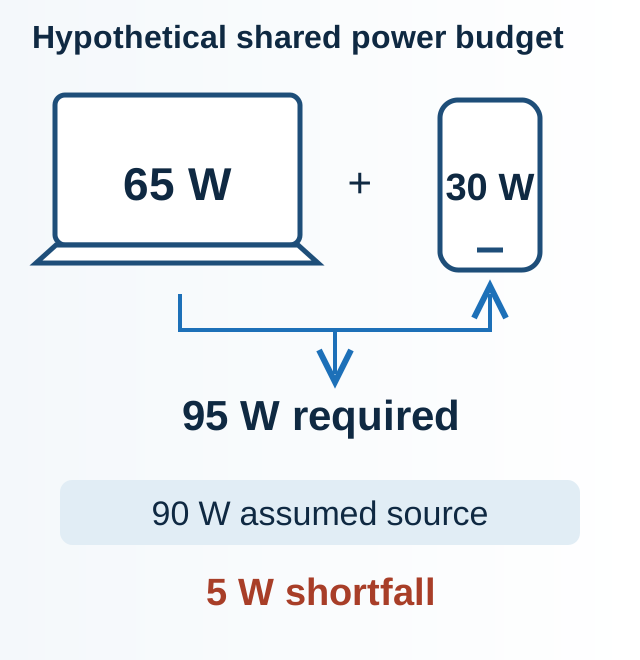
Assumed demand shows when a shared budget is insufficient. Passing this addition check is only the first screen; verify the port allocation and protocol next.
For cable pairing, record the required power rating, length and connectors on a separate order line. The USB-IF cable program distinguishes cable power capability and e-marker testing. A USB-C shape does not establish every cable’s power or data capability. Use our USB-C cable selection page and power, data and video cable guide to keep these requirements separate.
How much energy or ownership cost could a different design save?#
Calculate energy from comparable efficiency data, at the same useful output and duty cycle. A GaN label does not supply those inputs. For an IT fleet, electricity may matter; for a reseller, wrong-version returns, cable omissions and document rework can be more relevant to the purchase decision.
Conversion loss (W) = useful output (W) × (1 ÷ efficiency − 1).
Hypothetical equal-output example: at 60 W output, an assumed 90% efficient converter loses 60 × (1 ÷ 0.90 − 1) = 6.67 W; at an assumed 94%, it loses 60 × (1 ÷ 0.94 − 1) = 3.83 W. The difference is 2.84 W. These efficiencies are example inputs, not Anker model specifications or a GaN-versus-silicon measurement.
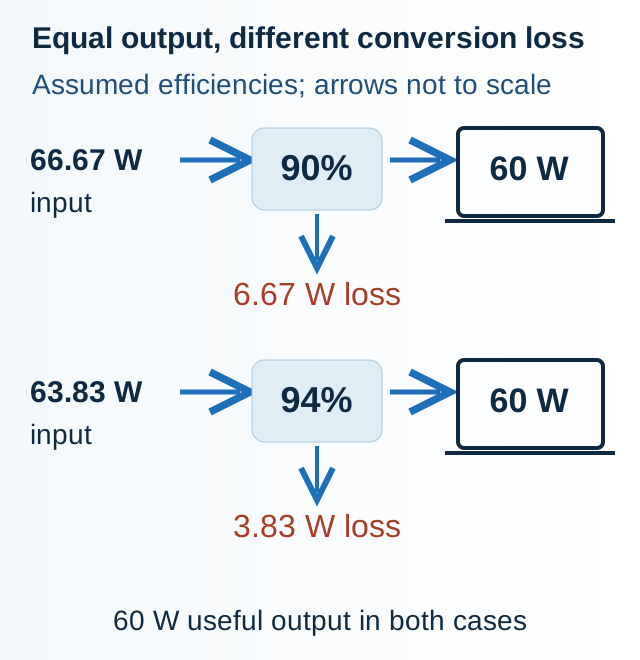
Hold useful output constant when comparing conversion losses. The diagram shows energy accounting, not a surface-temperature prediction.
Annual energy difference (kWh/unit) = loss difference (W) × hours/day × days/year ÷ 1,000.
With assumed use of 8 hours/day for 250 days/year, the unrounded loss difference gives (6.6667 − 3.8298) × 8 × 250 ÷ 1,000 = 5.67 kWh per unit per year. Multiply by your electricity tariff and installed unit count. Real charging demand varies, so use measured or manufacturer-documented efficiency across your actual loads; include standby energy separately.
Compare ownership costs over the same order quantity, delivery scope and evaluation period:
| Cost input | What to enter | Avoid double counting |
|---|---|---|
| Product and accessories | Current written quote for exact charger, plug and separately listed cables | Do not add a cable cost again if the quoted box includes it |
| Delivery and document handling | Packaging, handoff, onward freight and destination checks actually required | Use the same logistics responsibility for both options |
| Electricity for deployed equipment | Load-based energy, operating hours, standby and tariff | Do not charge an entire fleet’s use to one charger |
| Returns and support | Your recorded replacement, handling and support costs for comparable deployments | Separate product replacement from support time; do not invent a defect rate |
Same-period TCO = product and accessory cost + delivery and document costs + operating energy cost + recorded return/support costs. If efficiency data are unavailable, leave energy savings unquantified and compare the costs you can substantiate.
What should UL, FCC and CE evidence actually establish?#
Verify each claim against the exact regional model. UL certification, FCC compliance and CE marking answer different questions; a generic logo sheet cannot clear a wholesale lot for every market.
| Evidence area | What to request and check | What it does not establish |
|---|---|---|
| Electrical safety / UL claim | Exact-model safety documentation, applicable standard and edition; if UL certification is claimed, match the mark identifier/file and certification record | A semiconductor’s rating or a different model’s certificate cannot establish finished-charger certification |
| US FCC evidence | Ask which authorization procedure applies; where SDoC applies, retain model identification, compliance statement and US responsible-party contact information | FCC SDoC does not establish matters outside the FCC rules, or replace electrical-safety evidence |
| EU CE marking | Model-matched signed EU Declaration of Conformity, applicable legislation/standards and supporting technical evidence; reconcile the unit and plug version | A generic “CE certificate” or CE logo alone does not establish the correct conformity assessment |
| Lot and regional identity | Quote line, unit label, plug and packaging photos, with document references tied to the supplied version | A genuine product photo does not prove the identity or paperwork of the delivered lot |
The IEC 62368-1:2023 public abstract, corrected August 2025, describes a safety standard based on energy-source classification and safeguards. That scope is useful when reviewing a claimed test report. Ask a qualified compliance reviewer to confirm the relevant local adoption, edition and product coverage; the abstract supplies neither a charger-specific pass nor usable test limits.
UL’s mark guidance explains how an identifier or file number connects to Product iQ records. For FCC SDoC, 47 CFR § 2.1077 specifies compliance information, including the US responsible party, while § 2.1072 limits what SDoC signifies. Check applicability rather than demanding an FCC ID for every adapter.
The EU’s CE marking guidance places responsibility on the manufacturer and calls for the applicable conformity assessment, technical evidence and a signed declaration. There is no central EU body that issues permission to use CE. This matrix helps organize evidence; destination obligations still require a review for the exact product and sales channel.
What should you send for a wholesale quote?#
Send the actual device bundle and version requirements, then keep any unconfirmed fields visible in the written quotation. Start with the Anker GaNPrime range; use the existing charger wholesale checklist for the complete quote workflow.
| Item | Why we need it | Example format |
|---|---|---|
| Exact charger and plug | Defines the requested purchasing line | Model code; US/EU/UK plug; color; acceptable substitutes |
| Devices and concurrent output | Makes port allocation checkable | Laptop model and required profile; phone model; ports occupied together |
| Cable and box contents | Prevents an incomplete bundle | USB-C to USB-C; required power rating; length; included or separate |
| Market and evidence request | Identifies regional and documentation questions | Destination country; packaging language; safety/FCC/DoC references required |
| Quantity and handoff | Sets the commercial scope | Quantity per SKU; mainland China or Hong Kong handoff; onward transport owner |
Request a wholesale quote under the published pricing and RFQ terms with those inputs. The reply can address current availability, lead time, commercial terms and open questions. Confirm supporting-document availability in writing; a quote request does not itself certify a product or approve a market entry.
Method, sources and review date#
Updated October 19, 2026. This guide uses TI’s GaN mechanism explanation, Anker’s A2148 support specification and PowerIQ feature description, the IEC public abstract, UL mark guidance, USB-IF cable guidance, EU CE guidance last checked July 17, 2026, and eCFR rules available through the October 15, 2026 title issue. Links appear beside the relevant claims. The calculations use explicitly assumed inputs and equal useful output; obtain model-specific measurements before assigning an energy saving. No certification, efficiency, stock or price is inferred for an offered lot.